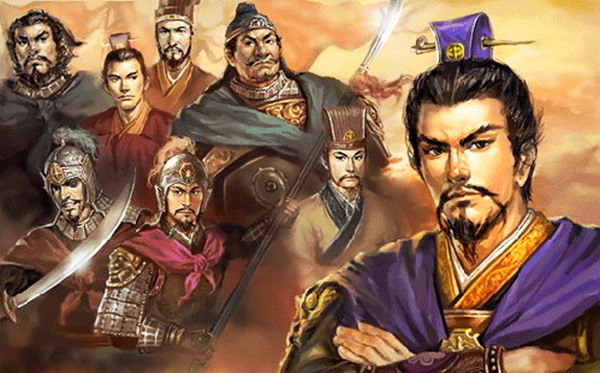
BATTLE
OF HULAO PASS – 190 AD
Read
chapter 5
-
Background
In
190, Dong Zhuo entered Luoyang, the capital of the Eastern Han Dynasty, and took
control of the imperial court. Dong Zhuo monopolised state power and governed
with cruelty and brutality. Later that year, several warlords and regional
officials formed a new coalition against Dong Zhuo, with Yuan Shao as their
leader. The coalition first attacked Sishui Pass, one of the mountain passes on
the way to Luoyang. Dong Zhuo's general Hua Xiong, who was guarding Sishui Pass,
was slain by Guan Yu from the coalition, and the pass was captured by the
coalition. The coalition forces then marched on to Hulao Pass, situated some 50
li away from Luoyang.
-
The battle
Dong
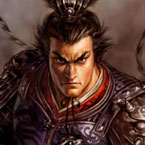
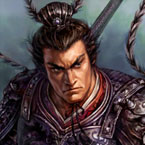
Zhuo personally led an army of 150,000 men with Lü Bu, Li Ru, Fan Chou, and
Zhang Ji east to Hulao Pass, while sending 50,000 men under Li Jue and Guo Si to
reinforce Sishui Pass. Once at Hulao Pass, Dong Zhuo ordered Lü Bu to lead the
vanguard with 30,000 men and set camp in front of the fortified
pass.
The
coalition decided to send half of their forces to engage Dong Zhuo's forces.
Eight coalition warlords - Wang Kuang, Qiao Mao, Bao Xin, Yuan Yi, Kong Rong,
Zhang Yang, Tao Qian, and Gongsun Zan - each led their forces towards Hulao Pass
under Yuan Shao's command. The first to arrive in Hulao Pass was Wang Kuang,
where one of his generals, Fang Yue, volunteered to duel Lü Bu. In less than
five rounds, Fang Yue was killed, and Lü Bu charged through Wang Kuang's force,
killing several of the routing soldiers. Fortunately for Wang Kuang, the forces
of Qiao Mao and Yuan Yi came to his rescue. They decided to withdraw 30 li from
the pass and set camp there.
Soon,
the remaining five coalition warlords arrived at the camp, where they discussed
and concluded that Lü Bu cannot be defeated by anyone. Just then, Lü Bu's men
arrayed outside the coalition camp, and the eight coalition warlords went to
meet the enemy. Mu Shun, a general under Zhang Yang, charged towards Lü Bu, but
was immediately killed. Wu Anguo, a general under Kong Rong, then proceeded to
challenge Lü Bu. They fought for ten rounds, but then Lü Bu slit off Wu Anguo's
wrist with his ji. The coalition forces charged out and rescued Wu Anguo, and
each side retreated to their own camps. Cao Cao commented that all the eighteen
warlords must gather together to discuss a plan to defeat Lü Bu, and that if Lü
Bu is defeated, Dong Zhuo would be easy to kill.
Just
then, Lü Bu came out again to taunt the coalition. This time, Gongsun Zan went
to challenge Lü Bu, but had to withdraw after a few rounds. Lü Bu gave chase,
but he was distracted by Zhang Fei, who called him "a slave with three
surnames". Lü Bu then battled Zhang Fei for 50 rounds, with neither gaining an
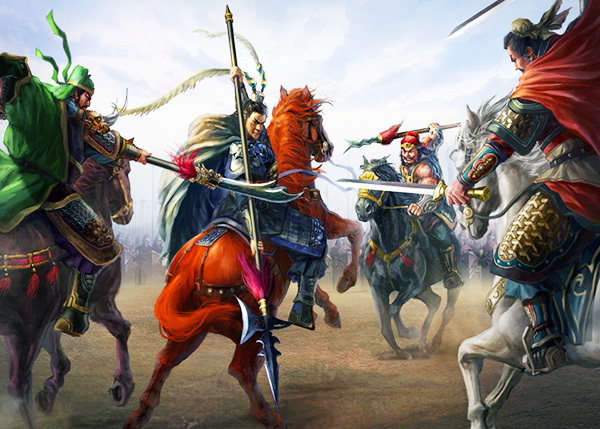
advantage over the other. Following that, Guan Yu, brandishing his Green Dragon
Crescent Blade, dashed out to assist Zhang Fei. The three fighters were engaged
in another 30 bouts or so when Liu Bei, holding up a pair of swords, also joined
in the fray.
The
three sworn brothers encircled Lü Bu and took turns to attack him from different
directions. Lü Bu was unable to defeat all three opponents so he pretended to
attack Liu Bei and escaped through the gap when Liu dodged his attack. Lü Bu
then fled back to Hulao Pass, with the three brothers hot on pursuit, but they
could not catch up with him because of the speed of his horse, the Red Hare.
They abandoned the chase after they spotted Dong Zhuo. Zhang Fei attempted to
charge onto the fortification to kill Dong Zhuo, but was driven back by a rain
of arrows from the pass.
The
coalition warlords declared the battle won, and received Liu Bei, Guan Yu and
Zhang Fei for a celebration of their victory.
-
Aftermath
In
the light of his recent defeat, Dong Zhuo consulted Li Ru, who suggested that
they retreat to Chang'an in the west. Dong Zhuo was delighted at the idea, and,
despite strong objections from some people, carried out the plan. He forced the
imperial court and Luoyang's citizens to migrate to Chang'an together with him,
with his army keeping close watch on them. Before leaving, Dong Zhuo sent his
soldiers to seize valuables and riches from the wealthy households in Luoyang,
and then had the city razed to the ground. Zhao Cen, Dong Zhuo's general
defending Sishui Pass at the time, abandoned the pass once he knew of his lord's
retreat.
BATTLE
OF XIAPI – 198 AD
Read
chapter 19
-
Background
In
194, while Cao Cao was away attacking Tao Qian in Xu Province, his subordinates
Chen Gong and Zhang Miao rebelled against him and aided Lü Bu in taking over his
base in Yan Province. Cao Cao abandoned his invasion of Xu Province and turned
back to attack Lü Bu, culminating in the Battle of Yan Province which lasted
more than 100 days. By 195, Cao Cao had retaken all his cities in Yan Province
and defeated Lü Bu at Juye. Lü Bu and his men fled east to join Liu Bei, who had
succeeded Tao Qian as Governor (州牧)
of Xu Province.
In
196, Cao Cao found Emperor Xian in the ruins of Luoyang and brought him to
Xuchang, where the new capital and imperial court would be based. In the same
year, Lü Bu took advantage of the conflict between Liu Bei and Yuan Shu to
capture Xiapi (present-day Pizhou, Jiangsu), capital of Xu Province, effectively
seizing control of the province from Liu Bei. Liu Bei was forced to surrender
his governorship of Xu Province to Lü Bu and settle in the nearby city of
Xiaopei. Not long later, Lü Bu felt threatened by Liu Bei's presence and led his
troops to attack Liu. Liu Bei was defeated by Lü Bu and had no choice but to
join Cao Cao. Cao Cao provided Liu Bei with supplies and sent him to garrison at
Xiaopei.
Around
197, Yuan Shao was in control of the three provinces of Ji, Qing and Bing north
of the Yellow River, so he wrote a letter to Cao Cao in an arrogant tone. Around
the same time, Cao Cao had just been defeated by Zhang Xiu at the Battle of
Wancheng and the letter angered him. Cao Cao felt threatened by Yuan Shao's
growing influence in northern China and wanted to attack Yuan, but felt that his
forces were not strong enough. Cao Cao's strategists Guo Jia and Xun Yu assessed
the situation, listing out the various advantages Cao Cao had over Yuan Shao.
They also advised him to use the opportunity to eliminate Lü Bu when Yuan Shao
was at war with Gongsun Zan, because it was possible that Yuan Shao might ally
with Lü Bu to attack him. Cao Cao then made preparations for a campaign against
Lü Bu.
-
The battle
*Conflict
between Lü Bu and Yuan Shu:
In
197, Yuan Shu declared himself emperor and sent his official Han Yin to meet Lü
Bu, proposing a marriage between his son and Lü Bu's daughter, so as to foster a
stronger alliance between him and Lü Bu. Lü Bu initially agreed to the proposal
and sent his daughter to follow Han Yin back. However, Lü Bu still bore a grudge
against Yuan Shu for attacking him five years ago, so he changed his mind after
listening to Chen Gui. Lü Bu pursued the convoy and retrieved his daughter,
captured Han Yin and sent him to Xuchang, where Han was executed on Cao Cao's
order. Cao Cao appointed Lü Bu as General of the Left (左將軍)
and personally wrote him a letter to console him. Lü Bu sent Chen Deng to meet
Cao Cao and thank Cao on his behalf. When Chen Deng met Cao Cao, he said that Lü
Bu was bold but not very astute, and was untrustworthy, so he should to be
eliminated as soon as possible. Cao Cao agreed with Chen Deng's view. Chen Deng
was appointed Administrator of Guangling and secretly implanted by Cao Cao as a
spy in Lü Bu's forces.
On
the other hand, Yuan Shu was angered by Lü Bu's betrayal, so he sent his
generals Zhang Xun, Qiao Rui to lead an army to attack Xiapi from seven
directions in collaboration with the White Wave Bandits led by Han Xian and Yang
Feng. Lü Bu was in an disadvantageous situation, with only 3,000 men and 400
warhorses. He was afraid that he might not be able to resist Yuan Shu so he
blamed Chen Gui for giving him poor counsel. Chen Gui, however, thought that Han
Xian and Yang Feng were not genuinely loyal to Yuan Shu, so he advised Lü Bu to
persuade them to break their alliance with Yuan Shu. When Lü Bu attacked Yuan
Shu's forces, Han Xian and Yang Feng defected to his side. Yuan Shu's troops
were defeated and Lü Bu pursued them until he reached south of the Huai
River.
*Siege
of Xiapi:
In
198, Lü Bu made peace with Yuan Shu again, and sent his general Gao Shun to
attack Liu Bei at Xiaopei. Cao Cao sent Xiahou Dun with an army to reinforce Liu
Bei, but they were still defeated by Gao Shun. Xiaopei fell to Lü Bu's forces in
the ninth lunar month and Liu Bei escaped but his wives were
captured.
Following
that, Cao Cao officially launched his military campaign against Lü Bu. When Cao
Cao's army reached Pengcheng (present-day Xuzhou, Jiangsu), Chen Gong urged Lü
Bu to attack Cao Cao because Cao Cao's troops were weary from their long march
from Xuchang. Lü Bu, however, insisted on staying in Xiapi and wait for Cao Cao
to arrive before attacking. A month later, Cao Cao conquered Pengcheng. At the
same time, Chen Deng defected to Cao Cao's side and led his men from Guangling
to Xiapi. Lü Bu personally lead his troops out to engage the enemy but was
defeated and forced to retreat. Lü Bu returned to Xiapi and defended the city
firmly without advancing.
Cao
Cao wrote a letter to Lü Bu, explaining the perilous situation the latter was
in. Lü Bu became afraid and had the intention of surrendering, but Chen Gong
felt that Cao Cao's army had travelled a long distance and would not be able to
fight a prolonged battle. Chen Gong advised Lü Bu to garrison part of his forces
outside the city, while the rest would remain with him inside, so that they can
support each other if either side came under attack. Chen also said the best
time to engage Cao Cao's forces would be months later, when Cao's supplies run
out. Lü Bu agreed with the plan and wanted to leave Chen Gong and Gao Shun
behind to defend Xiapi while he was stationed outside the city. However, Lü Bu's
wife claimed that Chen Gong and Gao Shun could not get along with each other, so
that would be a problem if Lü Bu was not around. She also felt that Cao Cao
treated Chen Gong better (before the latter's defection to Lü Bu) than how Lü Bu
was treating Chen now, so Chen might betray Lü Bu. Lü Bu thus aborted Chen
Gong's plan.
Lü
Bu sent Wang Kai and Xu Si (許汜)
to request reinforcements from Yuan Shu, but Yuan rejected when he recalled how
Lü Bu reneged on the marriage proposal earlier. Wang Kai and Xu Si attempted to
persuade Yuan Shu to send aid, claiming that Yuan Shu would be isolated if Lü Bu
was eliminated. Yuan Shu considered sending relief forces, but did not do so
immediately. In the meantime, Lü Bu thought that Yuan Shu was unwilling to help
him because of the marriage proposal incident, so he personally escorted his
daughter out of Xiapi and attempted to send her to Yuan Shu's territory.
However, Lü Bu encountered Cao Cao's troops outside the city and was unable to
break out of the siege so he had to turn back.
Cao
Cao's troops began to become tired and weary after failing to capture Xiapi
despite besieging it for a long time. Cao Cao had the intention of withdrawing,
but his strategists Xun You and Guo Jia thought that Lü Bu's army was already
low on morale after having suffered so many defeats, so they advised Cao Cao to
press on the siege. Cao Cao then ordered his soldiers to direct the waters of
the Yi and Si rivers to flood Xiapi. The beleaguered Lü Bu prepared to surrender
after Xiapi was flooded for over a month, but Chen Gong stopped
him.
*Lü
Bu's surrender:
Lü
Bu's general Hou Cheng found a man to help him take charge of 15 horses but the
man escaped with the horses, planning to present them to Liu Bei. Hou Cheng
personally pursued the man and retrieved the horses. The other generals
congratulated Hou Cheng on his achievement and Hou prepared food and wine and
presented to Lü Bu. Lü Bu was furious and said, "I ordered a ban on alcohol, and
now you prepare wine. Are you planning to make me drunk and then turn against
me?" Hou Cheng was unhappy and afraid, so in the 12th lunar month of 198, he
plotted with Song Xian and Wei Xu to capture Chen Gong and Gao Shun before
surrendering to Cao Cao.
When
Lü Bu heard about Hou Cheng's defection, he led his remaining men to White Gate
Tower, where he saw that Cao Cao's troops were closing in on him. He asked his
men to kill him and bring his head to Cao Cao, but they refused. Lü Bu then
surrendered.
-
Aftermath
Lü
Bu and his followers were tied up and brought before Cao Cao and Liu Bei. Cao
Cao ordered Gao Shun to be executed after Gao did not reply when Cao asked him
if he had anything to say. Lü Bu complained that he was too tightly bound but
Cao Cao said, "A tiger should be tightly tied up." Lü Bu then attempted to
persuade Cao Cao to spare him and promised to serve Cao. As Cao Cao was
pondering, Liu Bei said, "Haven't you seen what happened to Ding Yuan and Dong
Zhuo?" Cao Cao rubbed his jaw. Lü Bu scolded Liu Bei, "You're the most
untrustworthy person." The Yingxiong Ji (英雄記;
Records of Heroes) stated that Cao Cao initially wanted to spare Lü Bu's life
after Lü pledged to serve him. However, Wang Bi (王必),
Cao Cao's registrar, immediately stopped Cao Cao and said, "Lü Bu is a
formidable prisoner-of-war. His subordinates are nearby, he cannot be spared."
Cao Cao then said to Lü Bu, "I wanted to spare you, but my registrar refuses.
So, what should I do?"
When
Cao Cao asked Chen Gong what would happen to his family members, Chen hinted
that Cao should spare them. Cao Cao spared Chen Gong's family and treated them
well. Chen Gong then accepted his fate and walked to the execution ground
without looking back. Cao Cao was deeply grieved by Chen Gong's death. Cao Cao
then had Lü Bu executed by hanging. He ordered the dead bodies of Lü Bu and his
followers to be decapitated and their heads sent to Xuchang and then later
buried.
Cao
Cao accepted Zhang Liao, Chen Qun and others who previously served Lü Bu, and
appointed them as generals or officials under him. Other minor warlords such as
Zang Ba, Sun Guan (孫觀),
Wu Dun (吳敦),
Yin Li, and Chang Xi (昌豨)
who used to side with Lü Bu also surrendered to Cao Cao, and he put them in
charge of various commanderies along the coastline.
With
the end of the Battle of Xiapi, Cao Cao completely eliminated the threat posed
by Lü Bu. The following year, Liu Bei broke ties with Cao Cao and seized control
of Xu Province after killing Che Zhou (車冑),
but Cao Cao quickly defeated Liu and regained control of the province. With Xu
Province now firmly in his control, Cao Cao no longer had any impending threats
on his home base in Yan and Yu provinces. This became an advantage to Cao Cao in
the subsequent Battle of Guandu in 200 against Yuan Shao.
BATTLE
OF GUAN DU – 200 AD
Read
chapter 30
-
Background
From
196 onwards, it became increasingly obvious that an armed confrontation between
the warlords Cao Cao and Yuan Shao was inevitable. Yuan Shao was in control of
the lands north of the Yellow River, namely the Hebei region, and had large and
powerful armies under his command. Cao Cao controlled most of the lands south of
the Yellow River and had the Emperor Xian with him in the new capital city of
Xu. The warlords saw each other as the barrier to their individual ambitions to
conquer and rule China. Thus, it seemed that a trial of strength between the two
warlords was inevitable.
Some
years before the battle, Yuan Shao's advisors Ju Shou and Tian Feng had foreseen
that Cao Cao would become a threat to their lord in his ambition to dominate
China. They advised Yuan Shao to start a campaign against Cao Cao when the
latter was still building up his forces, but Yuan Shao ignored their advice as
Cao Cao was still nominally his ally. Tension between Cao Cao and Yuan Shao
started to build up after Cao Cao moved Emperor Xian from the old capital
Luoyang.
-
Prelude
The
geographical position of Guandu (官渡;
northeast of present-day Zhongmu County, Henan) made it a militarily strategic
position. It was near Yan Ford (延津;
north of present-day Yanjin County, Henan) on the Yellow River and laid on the
road leading to the capital city Xu. Cao Cao recognized its strategic importance
and in the autumn of 199, he stationed troops there and prepared fortifications.
Other deployments along the frontline included Liu Yan (劉延)
in Boma (白馬;
near present-day Hua County, Henan), Yu Jin in Yan Ford, Cheng Yu in Juancheng
(鄄城;
near present-day Juancheng County, Shandong), and Xiahou Dun in Meng Ford
(孟津;
present-day Mengjin County, Henan). At the same time, Cao Cao sent Zang Ba to
harass Qing Province (青州),
which was governed by Yuan Shao's son Yuan Tan, to prevent his eastern flank
from coming under attack.
In
the first month of 200, Liu Bei rebelled against Cao Cao and seized Xu Province
after killing Che Zhou (車冑),
Cao Cao's appointed Inspector (刺史)
of Xu Province. Cao Cao, in an unexpected move, left his northern front exposed
to Yuan Shao and turned east to retake Xu Province. Yuan Shao tried to use the
opportunity to start a campaign south, but was daunted by Yu Jin, the defender
of Yan Ford.
When
Cao Cao returned to Guandu after his victory over Liu Bei, who sought refuge
under Yuan Shao afterwards, Yuan Shao wished to renew the campaign against Cao
Cao. The aide-de-camp (參軍)
Tian Feng, who had urged Yuan Shao to attack Cao Cao while he was away, advised
against such a campaign, reasoning that they had lost their chance and must
wait. Yuan Shao ignored Tian Feng's repeated remonstrations and imprisoned him
under charges of demoralizing the army.
Shortly
after, Yuan Shao had Chen Lin draft a document condemning Cao Cao in what is
essentially a declaration of war, and marched his main army toward the forward
base of Liyang (黎陽;
northwest of present-day Xun County, Henan) north of the river. At the time,
Yuan Shao's army boasted of numbers up to 110,000, including 10,000
cavalry.
-
Skirmishes along the Yellow River
Yuan
Shao's general Yan Liang crossed the Yellow River and attacked Cao Cao's fort at
Boma, besieging it. Heeding his advisor Xun You's advice, Cao Cao led a
battalion toward Yan Ford as a feint to trick Yuan Shao into believing that Cao
Cao would attack his camp on the other side of the river. Yuan Shao split off
his troops from Liyang to counter Cao Cao's attack. Hence Yan Liang's siege at
Boma across from Liyang became unsupported. Cao Cao then struck eastward to lift
the siege on Boma. In the ensuing battle, Yan Liang was killed by Guan Yu and
Yuan Shao's troops were routed.
Cao
Cao then decided to abandon the fort and evacuated its occupants southward.
Taking advantage of the situation, Yuan Shao's forces of 6,000 light cavalry led
by Wen Chou and Liu Bei set off in pursuit. However, Cao Cao anticipated the
attack and prepared a distraction tactic. He ordered his troops to discard their
steeds, weapons and other valuables along the way. Yuan Shao's forces were
tempted by greed and broke their ranks to grab the valuables lying ahead. Just
as they were grabbing valuables, Cao Cao's 600 elite cavalry, which had been
lying in ambush, attacked. In the chaos, Yuan Shao's commander Wen Chou was
killed and Liu Bei fled. Even before the main engagement at Guandu, these
relatively minor skirmishes inflicted a crushing blow to the morale of Yuan
Shao's army as Yuan Shao had already lost two elite generals at the start of the
campaign.
-
The advance on Yangwu and flanking attempts
Cao
Cao was aware that he was fighting under disadvantageous conditions, thus he
abandoned the forward bases along the Yellow River to prepare for a determined
defence at Guandu. Cao Cao also ordered his officials in charge of his lands in
his absence to govern with lenience, so as to minimise chances of chaos within
the civilian community that could affect his army's
morale.
After
the engagements at the river, Yuan Shao's army pushed to Yangwu (陽武;
near present-day Yuanyang County, Henan), directly north of Guandu, and began
constructing earthen fortifications. By doing so he had ignored Cheng Yu's
bastion of 700 men at Juancheng, and possibly missed an opportunity to attack
Cao Cao's eastern flank. This was according to Cheng Yu's prediction earlier
that Yuan Shao would ignore a position with so few men. Yuan Shao's Attendant
Officer (從事)
Ju Shou had reservations about concentrating all of the main army at Yangwu, and
suggested to leave a garrison at Yan Ford as a step of caution in case the
attack on Guandu did not go well. Yuan Shao ignored the suggestion again. Ju
Shou, in despair, tried to excuse himself by claiming to be ill, but Yuan Shao
became annoyed at him and would not grant him leave. Instead, he divested Ju
Shou's men and divided them under the commands of Guo Tu and Chunyu
Qiong.
Yuan
Shao reorganized his forces and sent Liu Bei with an army to support the
rebellions against Cao Cao in Yinjiang (氵隱疆;
southwest of present-day Xuchang), just 20 li south of the capital. Cao Cao
became concerned about such developments in his rear, but his cousin Cao Ren
observed that Liu Bei could not have too much control over his new men given by
Yuan Shao. So Cao Cao sent Cao Ren to deal with the rebellion. Cao Ren
succeeded, killing the rebel leader Liu Pi and routing Liu Bei. Yuan Shao also
tried to cut off Cao Cao from the west by sending Han Meng (韓猛)
southwest. Cao Ren again responded to the threat by defeating Han Meng at Mount
Jiluo (雞洛山;
50 li northeast of present-day Xinmi, Henan). Yuan Shao did not send any
detached force into Cao Cao's territory after this.
At
Yangwu, several war plans were presented to Yuan Shao. Ju Shou observed that Cao
Cao's men were running out of grain, and thus it would be proper to enter a war
of attrition, denying Cao Cao a decisive battle. Another advisor, Xu You
suggested that Yuan Shao should maintain the front at Guandu but at the same
time send men to circle around and capture the emperor in Xu. Yuan Shao accepted
neither plan, saying he preferred to capture the emperor with a direct advance.
Xu You was not pleased.
-
The siege of Guandu
In
the eighth month, Yuan Shao's army slowly advanced southward from Yangwu and
engaged Cao Cao's men in trench warfare, behind the earthen embankments that
both sides made. Both sides harassed each other with engines of war. Yuan Shao
had erected siege-ramps and high platforms which allowed his men to rain arrows
onto Cao Cao's forces. In response, Cao Cao's men had to carry their shields
above their heads, and retaliated with traction trebuchets that destroyed the
archer platforms. Yuan Shao also tried to tunnel under Cao Cao's fort, but Cao
Cao had a large ditch dug within his lines to block the tunnels. Subsequently,
neither side could overcome each other as Cao Cao and Yuan Shao became locked in
a stalemate.
Before
long, Cao Cao's army began to run short of supplies and Cao Cao was in a dilemma
on whether to retreat in order to lure Yuan Shao deeper into his territory. Xun
Yu, the defender of the capital Xu, sent Cao Cao a letter dissuading him from
retreat. He wrote, drawing historical examples from the Chu–Han
Contention:
...your
military supplies are low, but they are not as bad as the situation of Chu and
Han at Xingyang and Chenggao. At that time neither Liu nor Xiang were willing to
be the first to retreat. The first to retreat reveals that his strength is
exhausted. You, Duke, with one-tenth of the enemy's force you have held the
ground you marked, and gripping him by the throat, have not let him advance for
already half a year. In this situation his strength will be exhausted and there
must arise some crisis. This is the time for employing unexpected stratagems;
you may not miss this opportunity.
Cao
Cao followed this advice and held fast to his ground. In the ninth month, Xun Yu
pointed out that Yuan Shao had been storing supplies at a depot in the village
of Gushi (故市;
southwest of present-day Yanjin County, Henan), guarded by Han Meng. Cao Cao
sent out small cavalry units led by Xu Huang and Shi Huan (史渙)
to attack this position. They succeeded, routing Han Meng, disrupting Yuan
Shao's supply lines, and burning his grain carts. Yuan Shao was forced to call
for relief supplies in response to this raid.
-
The raid on Wuchao
In
the tenth month, Yuan Shao's general Chunyu Qiong returned with an army of
10,000 from Hebei escorting large reserves of food supplies. Yuan Shao ordered
Chunyu to escort the supplies to Wuchao (烏巢;
in present-day Yanjin County, Henan), a place 40 li away from Guandu near Gushi,
and placed him in charge of guarding the supplies there. Yuan Shao's advisor Ju
Shou argued that Wuchao, being their important supply depot, was too lightly
guarded and insisted that Yuan Shao should send the general Jiang Qi
(蔣奇)
to serve as a perimeter guard to Chunyu Qiong and cut off any potential raids.
Yuan Shao, again, did not heed Ju Shou's advice.
Shortly
after, Yuan Shao's advisor Xu You, who had harboured dissatisfaction against
Yuan Shao for not using his plan and having his wife arrested by Shen Pei,
defected over to Cao Cao. He understood Cao Cao's shortage of supplies and
alerted Cao Cao to Yuan Shao's exploitable weakness at Wuchao. Cao Cao's
generals were suspicious of this piece of intelligence, but his advisors Xun You
and Jia Xu urged Cao Cao to put Xu You's plan to action. Thus at night, Cao Cao
led 5,000 infantry and cavalry to attack Wuchao after leaving Cao Hong and Xun
You in charge of his main camp at Guandu. Cao Cao's army disguised itself as a
reinforcement unit from Yuan Shao and attacked Wuchao. Chunyu Qiong's initial
defences were overrun, and he retreated to hold his forts, which Cao Cao
attacked and set on fire.
When
Yuan Shao's camp received the news that Wuchao was under attack, Zhang He urged
Yuan Shao to send reinforcements to Wuchao to save the supplies, on which the
fate of the campaign hinges. Guo Tu, however, advocated the opposite: attack Cao
Cao's base at Guandu with the hope that Cao Cao will abandon the raid on Wuchao.
Yuan Shao used Guo Tu's idea and sent Zhang He and Gao Lan to lead his main army
to attack Cao Cao's main camp at Guandu, while only sending a small cavalry unit
to reinforce Wuchao.
With
incredible bravado, Cao Cao ignored pleas to split off his force to deal with
the reinforcements, thus his men were prepared to fight to the death. The raid
on Wuchao was a great success, with Yuan Shao's casualties over a thousand. Yuan
Shao's generals Lü Weihuang, Han Juzi, Sui Yuanjin, and Zhao Rui (趙叡)
were decapitated; Chunyu Qiong was captured by Yue Jin and had his nose cut off.
Almost all of Yuan Shao's food supplies at Wuchao were
burnt.
By
dawn, Wuchao had turned into an inferno and the morale of Yuan Shao's army
plummeted sharply due to the loss of food supplies. Cao Cao also cut off the
noses of the dead, mixed them with noses and lips of oxen and horses, and showed
them to Yuan Shao's men, as a form of intimidation.
Meanwhile
at Guandu, Yuan Shao's army led by Zhang He and Gao Lan failed to break through
the enemy lines. Affected by the news of the defeat in Wuchao and rumors of Guo
Tu making slanderous remarks about them, Zhang He and Gao Lan surrendered to Cao
Hong and destroyed their weapons. The morale of Yuan Shao's army was drastically
weakened and Cao Cao's forces seized the opportunity to launch the full attack
on Yuan's army. Yuan Shao's numerous armies were destroyed and much of his
supplies were captured by Cao Cao. Yuan Shao himself fled north across the
Yellow River with only about 800 cavalry, which was what was left of his army.
Order was restored only when Yuan Shao reached the camp of his general Jiang
Yiqu, from where he gathered his straggling troops.
Some
of Yuan Shao's men could not cross the Yellow River in time and were captured by
Cao Cao, including Ju Shou. Some of these men had feigned surrender so they
could escape later, thus Cao Cao had these men buried alive. In his proclamation
of victory to Emperor Xian, Cao Cao claimed to have killed 70,000 enemy
troops.
-
Aftermath
Cao
Cao's victory at the Battle of Guandu was a decisive one and marked the turn of
the tide in his struggle for power with Yuan Shao. Yuan Shao died two years
later and his youngest son Yuan Shang was made his successor. His oldest son
Yuan Tan was furious with the succession and fought with his younger brother.
This resulted in internal conflict within Yuan Shao's forces. Yuan Shao's pool
of talented advisors and generals were also divided into two factions by the
conflict - one supported Yuan Shang and the other supported Yuan Tan. Cao Cao
seized the opportunity to launch an attack on Yuan Tan's base at Liyang. Though
Cao Cao eventually withdrew, Yuan Tan came to resent Yuan Shang even more during
course of the battle, which led to open warfare between the brothers. Yuan Tan
eventually allied with to Cao Cao against Yuan Shang, but Cao Cao accused him of
violating some terms of the alliance and killed him in battle. On the other
hand, Yuan Shang suffered defeats at the hands of Cao Cao and fled north to join
his second brother Yuan Xi. Cao Cao's forces pursued them and defeated the
Wuhuan tribe, the Yuan brothers' ally, in the Battle of White Wolf Mountain.
Yuan Shang and Yuan Xi fled to Liaodong to seek shelter under the warlord
Gongsun Kang in 207, but Gongsun killed them instead and sent their heads to Cao
Cao. By then, most of northern China was unified under Cao Cao's control, and
Cao Cao could begin to turn his attention to the south.

|
BATTLE
OF CHANGBAN – 208 AD
Read
chapter 41
-
Background
After
Cao Cao unified northern China in 207, he made arrangements for a southern
campaign on Jing Province (荊州;
covering present-day Hubei and Hunan), governed by Liu Biao at the time. Initial
minor invasions led by Xiahou Dun were repelled by Liu Biao's vassal Liu Bei,
whose forces were stationed at Xinye at the northern border of Jing Province.
Following that, Cao Cao personally led his armies south to attack Jing province
in the seventh lunar month of 208.
In
the eighth month, when Cao Cao's forces had reached Wancheng (present-day
Nanyang, Henan), Liu Biao died of illness and was succeeded by his younger son,
Liu Cong. Liu Cong's advisers Kuai Yue and Fu Xun (傅巽)
convinced Liu Cong that he could not resist Cao Cao even with Liu Bei's help, so
Liu Cong agreed to surrender. Liu Bei, who was at Fancheng at the time, was not
informed of Liu Cong's decision to surrender. When Liu Bei became suspicious, he
sent an attendant to Xiangyang to question Liu Cong, and only then would Liu
Cong pass the news to Liu Bei through his subordinate official Song Zhong
(宋忠).
Dismayed, Liu Bei drew his sword on Song Zhong, but did not kill him. Surrender
was not an option to Liu Bei, since he had been involved in an assassination
plot to remove Cao Cao when Liu was in the service of Cao roughly ten years ago
and it was unlikely that Cao would forgive him.
Liu
Bei then called for a council of his advisors. Zhuge Liang suggested that Liu
Bei should attack Liu Cong to secure Jing Province and defend against Cao Cao
there, but Liu Bei rejected this and said, "as Liu Jingzhou (Liu Biao) was
dying, he entrusted his orphans to me. I cannot turn from this obligation and
seek my own advantage. How am I to face Liu Jingzhou after I die?". Not willing
to fall under the hands of Cao Cao, Liu Bei gathered his men and marched to the
south. As he passed Xiangyang he called out to Liu Cong, but Liu Cong dared not
see him and hid. Many officials and civilians of Xiangyang followed Liu Bei as
he left, as he was greatly respected by the people.
In
the ninth month, Liu Cong set out from Xiangyang towards Xinye to receive Cao
Cao, surrendering Jing Province. Cao Cao took over the command of Jing
Province's military, especially its naval fleet, a component which Cao Cao's
forces lacked. Fearing that Liu Bei would take the southern base of Jiangling,
Cao Cao swiftly gave chase to Liu Bei with 5,000 elite horsemen, leaving his
baggage behind. As Liu Bei was bringing along more than 100,000 unarmed people
and thousands of carts of luggage, his force could not move very quickly.
Someone suggested to Liu Bei that he should abandon the people for his safety,
but Liu Bei did not have the heart to desert them when the people risked their
own lives to follow him. Instead, Liu Bei had Guan Yu sail ahead down the Han
River with a detachment of several hundred ships and take a roundabout route to
Jiangling, where they planned to rendezvous.
-
The battle
Cao
Cao's cavalry caught up to Liu Bei's congregation at Changban, Dangyang
Commandery, and Liu Bei had to flee for his life, galloping away south with
Zhang Fei, Zhao Yun and Zhuge Liang, while leaving his family and the populace
behind. Cao Cao's forces captured all his army and his baggage. Xu Shu, a friend
of Zhuge Liang who was also serving Liu Bei at the time, requested leave from
Liu and left to serve Cao Cao after learning that his mother was captured by
Cao's men. Liu Bei's two daughters were also captured by Cao Chun in the
battle.
Zhang
Fei commanded 20 horsemen as rearguard. He held the river and broke the bridges
down; looking fierce and shaking his lance, he shouted, "I am Zhang Yide. Come
and battle me to the death!" None of Cao Cao's men dared to go near him, buying
time for Liu Bei to escape.
As
Zhang Fei retreated with Liu Bei, Cao Cao ordered his men to build pontoon
bridges and launch an assault, but a timely arrival of Guan Yu and his forces
prevented Cao Cao from fully attaining victory.
In
the chaos, Zhao Yun disappeared to the north, prompting suspicion that he had
surrendered to Cao Cao. When someone reported that to Liu Bei, Liu angrily threw
a handaxe and said "Zilong (Zhao Yun) would never desert me." Surely enough,
Zhao Yun came back with Liu Bei's infant son Liu Shan in his arms along with
Lady Gan. With this, Zhao Yun was promoted to General of the Standard
(牙門將軍).
Turning
east from Changban, Liu Bei and the remnants of his party had crossed the Han
River to the east where Liu Qi, Liu Biao's elder son, still held control of
Jiangxia Commandery (present-day Yunmeng County, Hubei). They met Guan Yu's
fleet and over 10,000 men led by Liu Qi in Hanjin (漢津).
Together, they sailed down the river to Xiakou.
Cao
Cao did not follow up in immediate pursuit. The main objective of his drive to
the south had been the base at Jiangling, and he pressed on south to secure that
base first.
-
Aftermath
After
the Battle of Changban, the land of Jing Province west of the Han River became
territories of Cao Cao. Cao Cao entered Jiangling and pacified the officials and
peasants there. Cao Cao's advisor Jia Xu suggested that Cao should make full use
of the resources in Jing Province to settle his troops before further
territorial expansions, but Cao Cao preferred to use the momentum from his
victories to attack Jiangdong next.
Lu
Su, a statesman under the Jiangdong warlord Sun Quan, was originally on a
mission to offer condolences for Liu Biao's death. By the time he reached Jing
Province, however, Liu Cong had already surrendered and Liu Bei had fled south.
Lu Su went to see Liu Bei at Changban and, after Liu's defeat, followed him to
Xiakou. There he asked where Liu Bei was heading after, and Liu replied that he
plans to take refuge under Wu Ju (吳巨),
an old friend, in the distant Cangwu Commandery (蒼梧;
eastern portion of present-day Guangxi). To this, Lu Su dissuaded Liu Bei from
joining Wu Ju, saying Wu was only an ordinary fellow who would not be
independent for long; and persuaded Liu Bei to form an alliance with his lord
Sun Quan against Cao Cao. Liu Bei was pleased at this suggestion, and sent Zhuge
Liang to follow Lu Su back to meet Sun Quan and secure the
alliance.
The
successful formation of the Sun-Liu alliance led to the Battle of Red Cliffs
shortly after in the same year, where the allied forces defeated Cao Cao's
overwhelming fleets, driving him back north and forming the basis of the Three
Kingdoms.
BATTLE
OF JIANGXIA – 208 AD
Read
chapter 39
-
Background
In
the spring of 208, Gan Ning, who defected from Huang Zu to Sun Quan's side,
suggested to his new lord to prepare a full assault on Jiangxia. Gan Ning
mentioned that Huang Zu was already old, and his right-hand men only knew how to
do business and bully lower-ranked officials, and Huang's arsenal had not been
replenished for some time.
Despite
opposition from his chief civil clerk, Zhang Zhao, Sun Quan still appointed Ling
Tong to lead the vanguard force, Lü Meng to be the naval commandant, and Zhou Yu
as Front Commander to regulate the operation. The campaign had two main
objectives: elimination of Huang Zu, who was responsible for the death of Sun
Quan's father Sun Jian at the Battle of Xiangyang; conquest of Jiangxia, which
stood in Sun Quan's path to dominating Jing Province (covering present-day Hubei
and Hunan).
-
The battle
*Initial
clashes
In
response to Sun Quan's aggression, Huang Zu assigned his general Zhang Shuo as
the vanguard, and Chen Jiu as the admiral, but he would stay behind the high
walls of Jiangxia to avoid conflict in the frontline. Before the battle started,
Zhang Shuo led his troop on a large vessel to reconnoitre the riverbank, but was
located by Ling Tong, who was also scouting the area. At the time, Ling Tong
only had tens of his closest warriors on a light vessel, yet he was able to
climb Zhang Shuo's vessel probably under the cover of nightfall or the disguise
as Zhang's own men, and surprise attacked his enemy. Zhang Shuo was slain by
Ling Tong, and his mariners were captured.
*Deadlock
Upon
hearing the news that Zhang Shuo was killed, Huang Zu immediately ordered Chen
Jiu to block the entrance of Miankou River with two of his largest capital ships
(mengchong) covered with ox-hide at the choke point. In addition, Huang had
strong men and archers ambushed on top of the cliff next to the river to thrown
down rocks and fire on large enemy vessels. To bring down Huang Zu's mengchongs,
Zhou Yu sent out his large vessels, but only to be destroyed by the rocks thrown
down from the cliff. After several hours of fighting, Zhou Yu realized Huang
Zu's arsenals were not that unchecked, and that Sun Quan's men were exhausted
and dealt with casualties by the heavy cross fire from the elite crossbows on
the mengchongs.
*Fall
of the great capital ships
To
change the tide of battle, Zhou Yu had Ling Tong and Dong Xi, along with 100
"die-hard" soldiers, donned two suits of armour each and charged towards the
enemy despite the rain of rocks from the cliff and heavy fire from the
mengchongs. Through fierce fighting, Ling and Dong finally succeeded in breaking
the connections between the two vessels, and the downfall of the mengchongs
aspired the fighting spirit of Sun Quan's forces. Lü Meng even engrossed in
melee combat, and had Chen Jiu killed in a duel. With the admiral gone, Huang
Zu's massive navy was annihilated by Sun Quan's smaller forces. Before the time
Lü Meng could eliminate Huang's navy, Ling Tong had led a separate command to
attack Jiangxia, and took over the city.
*Doom
of Huang Zu
Unable
to resist Sun Quan's forces, Huang Zu fled the city, but was caught up and
killed by a horseman named Feng Ze. His head was specifically requested by Sun
Quan to be placed inside a container for examination. After receiving Huang Zu's
head, Sun Quan presented it as a sacrifice at his late father Sun Jian's
temple.
-
Aftermath
*Conflict
between Ling Tong and Gan Ning
With
Huang Zu killed, Sun Quan had taken his revenge; however, Ling Tong's father,
Ling Cao, was killed by an arrow fired by Gan Ning during the previous Battle of
Xiakou, and had not be avenged. Thus, Ling Tong would attempt to provoke Gan
Ning during a banquet held in Lü Meng's house some time later. In the end, Sun
Quan settled this conflict through political maneuver, as he "exiled" Gan Ning
to station at Half Island, hence Ling Tong would perceive as justice
done.
*Abandonment
of Jiangxia
Liu
Biao's son Liu Qi wanted to succeed Huang Zu's position, and went east after Sun
Quan took away the captives. However, Liu Qi was not allowed the time to
solidify his control over Jiangxia because northern Jing Province had been
incorporated into Cao Cao's domain without much resistance after his father died
of illness. Therefore, Liu Qi stationed his troop at Han Ford, where he met Liu
Bei, who was escaping from Cao Cao's pursuit, they then joined forces and went
to Xiakou to ask help from Sun Quan. As Jiangxia was famous for being the cradle
of the Huang clan, Sun Quan gave up the idea to hold the city after he received
news that Cao Cao had acquired northern Jing Province. Liu Biao's general Wen
Ping, who defected to Cao Cao after Liu's death, became the new governor of
Jiangxia.
BATTLE
OF RED CLIFFS – 208 AD
Read
chapter 49
-
Background
By
the early 3rd century, the Han Dynasty, which had ruled China for almost four
centuries (albeit with a 16-year interruption, dividing the dynasty into its
Western and Eastern periods), was crumbling. Emperor Xian had been a political
figurehead since 189, with no control over the actions of the various warlords
controlling their respective territories. One of the most powerful warlords in
China was Cao Cao, who, by 207, had unified northern China and retained total
control of the North China Plain. He then completed a successful campaign
against the Wuhuan in the winter of the same year, thus securing his northern
frontier. Upon his return in 208, he was appointed Chancellor, a position that
granted him absolute authority over the entire imperial government. Shortly
afterwards, in the autumn of 208, his army began a southern
campaign.
The
Yangtze River in the area of Jing Province (covering present-day Hubei and Hunan
provinces) was key to the success of this strategy. If Cao Cao was to have any
hope of reuniting the sundered Han empire, he had to achieve naval control of
the middle Yangtze and command the strategic naval base at Jiangling as a means
of access to the southern region. Two warlords controlled the regions of the
Yangtze that were key to Cao Cao's success: Liu Biao, the Governor of Jing
Province, controlled the area west of the mouth of the Han River, roughly
encompassing the area around the city of Xiakou and all territory south of that
region. Sun Quan controlled the river east of the Han and the southeastern
territories abutting it. A third ally, Liu Bei, was living in refuge with Liu
Biao at the garrison in Fancheng (in present-day Xiangyang), having fled from
the northeast to Jing Province following a failed plot to assassinate Cao Cao
and restore power to the imperial dynasty.
The
initial stages of the campaign were an unqualified success for Cao Cao, as the
command of Jing Province had been substantially weakened and the Jing armies
exhausted by conflict with Sun Quan to the south. Factions had arisen supporting
either of Liu Biao's two sons in a struggle for succession. The younger son
prevailed, and Liu Biao's dispossessed eldest son, Liu Qi, departed to assume a
commandery in Jiangxia (present-day Yunmeng County, Hubei). Liu Biao died of
illness only a few weeks later, while Cao Cao was advancing from the north and,
under these circumstances, Liu Biao's younger son and successor, Liu Cong,
quickly surrendered. Cao Cao thus captured a sizeable fleet and secured the
naval base at Jiangling. This provided him with a key strategic military depot
and forward base to harbour his ships.
When
Jing Province fell, Liu Bei quickly fled south, accompanied by a refugee
population of civilians and soldiers. This disorganised exodus was pursued by
Cao Cao's elite cavalry, and was surrounded and decisively beaten at the Battle
of Changban (near present-day Dangyang, Hubei). Liu Bei escaped, however, and
fled further east to Xiakou, where he liaised with Sun Quan's emissary Lu Su. At
this point historical accounts are inconsistent; Lu Su may have successfully
encouraged Liu Bei to move even further east, to Fankou (樊口;
around present-day Ezhou, Hubei). In either case, Liu Bei was later joined by
Liu Qi and levies from Jiangxia. Liu Bei's main advisor, Zhuge Liang, was sent
to Chaisang (柴桑;
in present-day Jiujiang, Jiangxi) to negotiate forming a mutual front against
Cao Cao with Sun.
By
the time Zhuge Liang arrived, Cao Cao had already sent Sun Quan a letter
boasting of commanding 800,000 men and hinting that he wanted Sun to surrender.
The faction led by Sun Quan's Chief Clerk, Zhang Zhao, advocated surrender,
citing Cao Cao's overwhelming numerical advantage. However, on separate
occasions, Lu Su, Zhuge Liang, and Sun Quan's chief commander, Zhou Yu, all
presented arguments to persuade Sun Quan to agree to the alliance against the
northerners. Sun Quan finally decided upon war, chopping off a corner of his
desk during an assembly and stating: "Anyone who still dares argue for surrender
will be [treated] the same as this desk." He then assigned Zhou Yu, Cheng Pu,
and Lu Su with 30,000 men to aid Liu Bei against Cao Cao.
Although
Cao Cao had boasted command of 800,000 men, Zhou Yu estimated Cao Cao's actual
troop strength to be closer to 220,000. Furthermore, this total included 70,000
impressed troops from the armies of the recently deceased Liu Biao, so the
loyalty and morale of a large number of Cao Cao's force was uncertain. With the
20,000 soldiers that Liu Bei had gathered, the alliance consisted of
approximately 50,000 marines who were trained and prepared for
battle.
-
The battle
The
Battle of Red Cliffs unfolded in three stages: an initial skirmish at Red Cliffs
followed by a retreat to the Wulin (烏林)
battlefields on the northwestern bank of the Yangtze, a decisive naval
engagement, and Cao Cao's disastrous retreat along Huarong
Road.
The
combined Sun-Liu force sailed upstream from either Xiakou or Fankou to Red
Cliffs, where they encountered Cao Cao's vanguard force. Plagued by disease and
low morale due to the series of forced marches they had undertaken on the
prolonged southern campaign, Cao Cao's men could not gain an advantage in the
small skirmish which ensued, so Cao Cao retreated to Wulin (north of the Yangtze
River) and the allies pulled back to the south.
Cao
Cao had moored his ships from stem to stern, possibly aiming to reduce
seasickness in his navy, which comprised mostly northerners who were not used to
living on ships. Observing this, divisional commander Huang Gai sent Cao Cao a
letter feigning surrender and prepared a squadron of capital ships described as
mengchong doujian (蒙衝鬥艦).
The ships had been converted into fire ships by filling them with bundles of
kindling, dry reeds, and fatty oil. As Huang Gai's "defecting" squadron
approached the midpoint of the river, the sailors applied fire to the ships
before taking to small boats. The unmanned fire ships, carried by the
southeastern wind, sped towards Cao Cao's fleet and set it ablaze. Within a
short time smoke and flames stretched across the sky, and a large number of men
and horses either burned to death or drowned.
Following
the initial shock, Zhou Yu and the allies led a lightly armed force to
capitalise on the assault. The northern army was thrown into confusion and was
utterly defeated. Seeing the situation was hopeless, Cao Cao then issued a
general order of retreat and destroyed a number of his remaining ships before
withdrawing.
Cao
Cao's army attempted a retreat along Huarong Road, including a long stretch
passing through marshlands north of Dongting Lake. Heavy rains had reduced the
track to a thick mire, making the road so treacherous that many of the sick
soldiers had to carry bundles of grass on their backs and use them to fill the
road, to allow the horsemen to cross. Many of these soldiers drowned in the mud
or were trampled to death in the effort. To the misery of Cao Cao's army, the
allies, led by Zhou Yu and Liu Bei, gave chase over land and water until they
reached Nan Commandery (南郡;
present-day Jiangling County, Jingzhou, Hubei); combined with famine and
disease, this decimated Cao Cao's remaining forces. Cao Cao then retreated north
to his home base of Ye (in present-day Handan, Hebei), leaving Cao Ren and Xu
Huang to guard Jiangling, Yue Jin stationed in Xiangyang, and Man Chong in
Dangyang.
The
allied counterattack might have vanquished Cao Cao and his forces entirely.
However, the crossing of the Yangtze River dissolved into chaos as the allied
armies converged on the riverbank and fought over the limited number of ferries.
To restore order, a detachment led by Sun Quan's general Gan Ning established a
bridgehead in Yiling to the north, and only a staunch rearguard action by Cao
Ren prevented further catastrophe.
-
Analysis
A
combination of Cao Cao's strategic errors and the effectiveness of Huang Gai's
ruse had resulted in the allied victory at the Battle of Red Cliffs. Zhou Yu had
previously observed that Cao Cao's generals and soldiers comprised mostly
cavalry and infantry, and few had any experience in naval warfare. Cao Cao also
had little support among the people of Jing Province, and thus lacked a secure
forward base of operations. Despite the strategic acumen Cao Cao had displayed
in earlier campaigns and battles, in this case he had simply assumed that
numerical superiority would eventually defeat the Sun and Liu navy. Cao's first
tactical mistake was converting his massive army of infantry and cavalry into a
marine corps and navy: with only a few days of drills before the battle, Cao
Cao's troops were ravaged by sea-sickness and lack of experience on water.
Tropical diseases, to which the southerners had long been immune, also plagued
the soldiers of the north with the debilitating effects of sickness rampant in
Cao Cao's camps. Although numerous, Cao Cao's men were already exhausted by the
unfamiliar environment and the extended southern campaign, as Zhuge Liang
observed: "Even a powerful arrow at the end of its flight cannot penetrate a
silk cloth".
The
uncharacteristically poor preparation and miscalculations displayed by Cao Cao
during this campaign may have been partly due to the recent death of his
strategist and advisor Guo Jia. Cao Cao himself had commented: "Had Guo Jia been
with us, I would never have got into such trouble". Another key advisor, Jia Xu,
had recommended after the surrender of Liu Cong that the overtaxed armies be
given time to rest and replenish before engaging the armies of Sun Quan and Liu
Bei, but Cao Cao disregarded the advice. Cao Cao's own thoughts regarding his
failure at Red Cliffs suggest that he held his own actions and misfortunes
responsible for the defeat, rather than the strategies utilised by his enemy
during the battle: "...it was only because of the sickness that I burnt my ships
and retreated. It is out of all reason for Zhou Yu to take the credit for
himself.".
-
Aftermath
By
the end of 209, the post Cao Cao had established at Jiangling fell to Zhou Yu.
The borders of the land under Cao Cao's control contracted about 160 kilometres
(99 mi), to the area around Xiangyang. Liu Bei, on the other hand, had gained
territory by taking over the four commanderies (Wuling, Changsha, Lingling and
Guiyang) south of the Yangtze River. Sun Quan's troops had suffered far greater
casualties than Liu Bei's in the extended conflict against Cao Ren following the
Battle of Red Cliffs, and the death of Zhou Yu in 210 resulted in a drastic
weakening of Sun Quan's strength in Jing Province. Liu Bei also occupied Jing
Province that Cao Cao had recently lost — a strategic and naturally fortified
area on the Yangtze River that Sun Quan claimed for himself. The control of Jing
Province provided Liu Bei with virtually unlimited access to the passage into Yi
Province (covering present-day Sichuan and Chongqing) and important waterways
into Wu (southeastern China), as well as dominion of the southern Yangtze
River.
Never
again would Cao Cao command so large a fleet as he had at Jiangling, nor would a
similar opportunity to destroy his southern rivals present itself again. The
Battle of Red Cliffs and the capture of Jing Province by Liu Bei confirmed the
separation of southern China from the northern heartland of the Yellow River
valley, and also foreshadowed a north-south axis of hostility which would
resonate for centuries.
BATTLE
OF CHANGSHA – 208 AD
Read
chapter 53
-
Background
Han
Xuan, a former subordinate of Liu Biao, controlled the city of Changsha
following Liu Biao's death in 208 and Liu Cong's failed succession. Han Xuan and
another warlord Jin Xuan seceded from Jing Province following Cao Cao's
stalemated conquest of Jing Province.
Cao
Cao, Liu Bei, and Sun Quan all desired Jing Province, and Sun Quan had little of
the province except for the southern side of the Yangtze near Xiakou and Chibi.
Finding an opportunity to take Jing Province and a few other important
locations, Liu Bei dispatched Guan Yu to take Changsha and eliminate Han
Xuan.
-
The battle
When
Guan Yu led his forces towards Changsha, Han Xuan sent his general Yang Ling to
meet the enemy, but Yang Ling was killed. Han Xuan then sent Huang Zhong, who
fought with Guan Yu. Whilst fighting, both generals developed respect for each
other, and did not take opportunities to slay the other.
Han
Xuan saw this, and ordered Huang Zhong to be put to death. Wei Yan rescued Huang
Zhong by cutting down the executioner, then led a revolt to kill Han Xuan. Wei
Yan then surrendered the city to Guan Yu.
-
Aftermath
Huang
Zhong, Wei Yan and Liu Pan would all became prominent people of Shu Han
following their surrenders to Liu Bei. Huang Zhong would become a "Tiger
general" along with Guan Yu, Zhang Fei, Zhao Yun, and Ma Chao. He would fight in
the Hanzhong Campaign and kill Xiahou Yuan during a clash with Cao Cao's forces
at Battle of Mt. Dingjun. Liu Pan would become the magistrate of Changsha for
the Shu kingdom.
When
Wei Yan surrendered, Zhuge Liang ordered him to be executed, but Liu Bei
intervened. Zhuge Liang would always suspect Wei Yan, fearing he would again
revolt. Indeed, later in Chapter 104, after Zhuge Li.
BATTLE
OF TONG PASS – 211 AD
Read chapter 58 & chapter 59
-
Background
Before
the end of the Han Dynasty, the warlord Ma Teng commanded a sizable army in the
northwestern frontiers of China that threatened the North China Plain controlled
by Cao Cao. When Cao Cao finished his unification of northern China in 207, he
wished to turn south to attack Liu Bei and Sun Quan; so to avoid being attacked
from behind, Cao Cao appointed Ma Teng as an official and summoned him to Ye
City. Ma Teng and some of his family members were effectively held hostage to
prevent Ma Teng's son, Ma Chao, from invading Cao Cao's
territory.
Cao
Cao's southern expedition did not go well; however, as he was defeated by the
combined forces of Sun Quan and Liu Bei at the Battle of Red Cliffs in 208. He
soon turned his attention west instead, with the intention to invade Guanzhong.
In March 211, Cao Cao sent Zhong Yao to attack Hanzhong (Han'ning),[1] which was
controlled by Zhang Lu, while sending Xiahou Yuan to rendezvous with Zhong's
forces. Gao Rou cautioned Cao Cao against such a move, saying that sending
massive armies west could draw suspicion from the western warlords and cause the
latter to revolt. However, Cao Cao paid no heed to his
advice.
As
predicted, the western forces began suspecting an assault from Cao Cao, and soon
Ma Chao, Han Sui, Hou Xuan, Cheng Yin, Yang Qiu, Li Kan, Zhang Heng, Liang Xing,
Cheng Yi, and Ma Wan (馬玩)
rallied their armies and marched on Tong Pass (in present-day Tongguan County,
Shaanxi). The coalition comprised a mixture of Han Chinese, Qiang, and Hu
soldiers. Many counties of the area joined the uprising, and some civilians had
to escape into Hanzhong via Ziwu Valley (子午谷).
In
response, Cao Cao ordered Cao Ren to defend against the invading forces and
issued orders that they must refrain from engaging the
enemy.
-
The battle
In
July, Cao Cao left the capital to lead his troops against Ma Chao, while leaving
his son Cao Pi to defend his headquarters in Ye City. In August, his troops
arrived at Tong Pass where the standoff between his forces and the Guanxi forces
was taking place. As the standoff dragged on, more and more Guanxi
reinforcements came to Tong Pass, but Cao Cao seemed gleeful at every instance
of enemy arrival. When asked by his officers why he was so happy when the enemy
was gaining numbers, he replied "The road to Guanzhong is long, and if the
barbarians defended themselves along the treacherous terrain, we cannot conquer
them in one or two years. But now that they all assembled here in this uneasy
alliance, it will be much easier to eliminate them. That is why I am
happy."
Cao
Cao gave the Guanxi forces an impression that a frontal assault was imminent,
but had Xu Huang and Zhu Ling covertly travelled north. The two men had
slithered cross the Yellow River via Puban Ford (浦阪津)
to the west with 4,000 men, and pitchd camp there, circumventing Tong Pass. A
month later, Cao Cao's main force followed, while Cao Cao and Xu Chu guarded the
rear. When Ma Chao got wind of Cao Cao's maneuver, he led roughly 10,000 men to
give chase. Arrows poured down on the rearguard, but Cao Cao was in no hurry.
Seeing that the situation became dire, Xu Chu helped Cao Cao onto a boat, but
the ferryman was shot dead. Xu Chu then used a saddle to shield arrows with his
left hand, and paddled the boat with his right. Ma Chao's men kept on firing
arrows on Cao Cao's boat even though it had sailed for miles. It was then Ding
Fei (丁斐),
a general under Cao Cao, gave the command to release the livestock. Seeing this,
the pursuing army, being mostly herders, gave up on the chase and went for the
horses and oxen instead. It was through these efforts that Cao Cao safely
crossed the river.
Cao
Cao's force then regrouped with Xu Huang's, and marched south along the river.
The Guanxi armies then accordingly positioned themselves against attack from the
north. Then, Cao Cao sent out some decoy troops to distract enemy defense while
setting up a pontoon bridge crossing the Wei River that would allow his forces
to complete the circumvention of Tong Pass. At night, a portion of Cao Cao's
forces crossed the river and tried to set camp; however, the soil was too sandy
to be used for building fortification, and Ma Chao's cavalry soon chased away
the builders. Eventually, on the advice of Lou Gui, Cao Cao had his men pour
water on piled-up sand. The mixture froze in the cold night and became solid,
and thus a bridgehead was established south of the Wei River. The icey fortress
was shortly attacked by Ma Chao, but the attackers were repelled by Cao Cao's
ambushes.
As
the battle dragged on, Ma Chao attempted a ceasefire and requested the lands
west of the Wei River, but Cao Cao rejected. Ma Chao would try to entice Cao
Cao's men to attack his newly established camp, but Cao Cao did not bite the
bait. In an attempt to negotiate, Cao Cao, Han Sui, and Ma Chao came together
bringing no one but their close guards. Ma Chao had hoped that, with his
strength, he could capture Cao Cao and force him to agree to their terms, but he
had heard of the prowess of Cao Cao's bodyguard, so he asked, "Is the Tiger
Marquis with you today?" Cao Cao pointed at Xu Chu, who glared at Ma Chao, and
Ma dared not make a move.
To
avoid attrition, the generals of the Guanxi armies agreed to cede territories
and send their sons to Cao Cao as hostages in exchange for peace. Cao Cao's
strategist Jia Xu suggested that he could pretend to accept the terms, and then
turn the allied forces against each other. Cao Cao agreed, and arranged for an
armistice. Han Sui was sent by the Guanxi armies as the representative. He was
once a friend of Cao Cao, and when they met, they did not talk about military
affairs but instead recollected their youths in the capital, occasionally
clapping their hands and laughing amiably. When the meeting was over, Ma Chao
demanded to know what Cao Cao said, but Han Sui responded that it was nothing
much. Ma Chao became suspicious of Han Sui from there on. A few days later, Cao
Cao sent Han Sui a letter with certain words smudged out as if Han did it
himself. Ma Chao saw this letter and thought Han Sui was collaborating with Cao
Cao, and did not trust Han any more.
To
capitalize on this suspicion, Cao Cao set the time for a final clash between the
two forces. First, he challenged the allied forces with lightly armoured
soldiers, then surrounding the allied forces with heavy cavalry in both flanks.
The allies were routed and several commanders including Cheng Yi and Li Kan were
killed in battle. Han Sui and Ma Chao fled to Liang Province and Yang Qiu to
Anding (present-day Anding District, Gansu). Cao Cao emerged
victorious.
-
Aftermath
The
forces of Guanxi were unable to regroup again in a coalition and their strengths
were greatly weakened after this battle. Of the remnants of the coalition, Yang
Qiu soon surrendered, Han Sui was defeated by Xu Huang and Zhang He, and only Ma
Chao was actively causing trouble for Cao Cao.
After
Cao Cao's main army retreated due to an uprising back home, Ma Chao attacked the
commanderies in Longxi with the forces of the western tribes and the
commanderies took their lead from him, except for the city of Jicheng
(冀城,
capital of Tianshui Commandery). When he conquered Jicheng, Ma Chao killed the
Inspector of Liang Province, Wei Kang (韋康),
occupied the city and controlled Wei's forces. He called himself the General Who
Conquers the West and took over the governance of Bing Province and the military
matters of Liang Province. The deputies who served under Wei Kang, Yang Fu,
Jiang Xu (姜叙),
Liang Kuan (梁寬),
Zhao Qu (趙衢)
and others plotted against Ma Chao. Yang Fu and Jiang Xu revolted in Lucheng and
Ma Chao left Jicheng in an attempt to quell the uprising. Meanwhile, Liang Kuan
and Zhao Qu closed the gates of Jicheng and Ma Chao could not return to the
city. He had little choice but to seek refuge with Zhang Lu in
Hanzhong.
Later,
Cao Cao had Ma Teng's household executed for Ma Chao's uprising. Only Ma Chao
and his cousin Ma Dai remained in his once great family.
BATTLE
OF JIAMENG PASS – 212 AD
Read
chapter 65
-
Background
In
211, Ma Chao attacked Cao Cao after the latter lured his father (Ma Teng) and
younger brothers (Ma Xiu and Ma Tie) into a trap and killed them. This led to
the Battle of Tong Pass between Ma Chao and Cao Cao. Ma Chao was defeated and he
took refuge under the warlord Zhang Lu in Hanzhong.
-
The battle
In
212, Liu Zhang invited Liu Bei into Yi Province (covering present-day Sichuan
and Chongqing) to help him defend against Zhang Lu's forces in Hanzhong. Liu Bei
proceeded to Jiameng Pass (located about 20 kilometres northeast of Jianmen Pass
in present-day Jiange County, Sichuan) and stationed there. However, Liu Bei and
Liu Zhang eventually turned hostile towards each other when Liu Zhang discovered
that his follower Zhang Song had been plotting with Liu Bei to seize Yi Province
from him.
Liu
Zhang formed an alliance with Zhang Lu against Liu Bei. Zhang Lu sent Ma Chao to
lead an army to attack Liu Bei at Jiameng Pass. There, Ma Chao encountered Zhang
Fei and duelled with him. After engaging each other in two long separate fights,
neither Zhang Fei nor Ma Chao was able to gain an advantage over his opponent,
and they retreated back to their respective camps. Liu Bei did not want either
his sworn brother or Ma Chao to get hurt, so he consulted Zhuge Liang. Zhuge
Liang suggested that Ma Chao would be of great help to them if he was willing to
serve Liu Bei. Hence, Liu Bei sent Li Hui to persuade Ma Chao to switch
allegiance to him. Concurrently, Liu Bei also sent people to spread negative
rumours about Ma Chao in Hanzhong, causing Zhang Lu to become suspicious of Ma
Chao. Ma Chao heard that Zhang Lu was starting to doubt his loyalty and planned
to defect to Liu Bei, especially since Liu Bei was a rival of his sworn enemy,
Cao Cao.
-
Aftermath
At
that time, Liu Bei was besieging Liu Zhang in Yi Province's capital Chengdu,
when he received Ma Chao's request to serve him. Liu Bei was pleased and eagerly
accepted Ma Chao's assistance, and sent troops and supplies to Ma's camp.
Following that, Ma Chao led his army to attack Chengdu from the north. Liu Zhang
was shocked because he did not expect Ma Chao to make such a move. Shortly
later, Liu Bei's advisor Jian Yong managed to convince Liu Zhang to surrender,
and Yi Province came under Liu Bei's control. Ma Chao became one of the Five
Tiger Generals under Liu Bei after the latter defeated Cao Cao in the Hanzhong
Campaign and declared himself "King of Hanzhong".
BATTLE
OF FANCHENG – 219 AD
Read
chapter 74
-
Background
In
October 218, Cao Cao's general Hou Yin (侯音)
and his deputy Wei Kai (衛開)
of Wan (宛;
present-day Nanyang, Henan) rose in rebellion with several thousand troops, and
they requested Guan Yu for assistance. It would take four months for Cao Ren to
finally crush the rebellion by killing both Hou Yin and Wei Kai, but Guan Yu did
not respond to the rebels throughout the duration. After taking Hanzhong by
defeating Cao Cao in May 219, Liu Bei further expanded his gains in June 219 by
sending Meng Da and Liu Feng to take Fangling (房陵;
present-day Fang County, Hubei) and Shangyong (上庸;
north of present-day Zhushan County, Hubei). Cao Cao was temporarily forced to
be on the defensive after a continuous setback and Sun Quan of Jiangdong decided
to take the opportunity to attack Cao Cao while their newly defeated men were
regrouping and resting.
Realizing
the imminent attacks of Liu Bei and Sun Quan, Cao Cao planned to launch a
preemptive strike on Jing Province (荊州;
covering present-day Hubei and Hunan), the eastern part of Liu Bei's territory
defended by Guan Yu. The plan reasoned that Liu Bei could not continue his
offensive in the north due to the need to consolidate his new gains, and so an
attack into Jing Province would not be hindered by Liu's invasion elsewhere.
However, the plan was called off because Cao Cao's troops still needed time to
recover, regroup and re-supply from the campaign to suppress the rebellion of
Hou Yin and Wei Kai, as well as from earlier setbacks in the struggles for
Hanzhong. The worn-out troops were not ready for another
campaign.
-
The battle
*Initial
stages
In
July, 219, Sun Quan mobilized his forces in preparation to attack Hefei, and Cao
Cao's forces were redeployed to the region to the south of the Huai River to
fend off the possible invasion. Seizing the opportunity, Guan Yu decided to
launch an offensive of his own against Cao Cao. Mi Fang, Administrator of Nan
Commandery (南郡;
present-day Jiangling County, Hubei) was ordered to stay behind to guard
Jiangling (江陵)
city of Nan Commandery, while general Shi Ren was ordered to stay behind to
guard Gong'an (公安;
northwest of present-day Gong'an County, Hubei). Liu Bei's main force in the
region was led by Guan Yu himself to attack Cao Cao's strongholds in the
north.
The
campaign's objective was not clearly stated, but Guan Yu led his army along the
Han River northward until he laid siege to Fancheng (present-day Fancheng
District Xiangyang, Hubei). From the advance route and the fact that Guan chose
to concentrate his main forces on Fancheng, his primary objective was believed
to be the conquest of Nanyang commandery. Initially, the cities being attacked
were not heavily guarded, as Cao Ren at Fancheng and Lü Chang (呂常)
at Xiangyang (襄陽;
present-day Xiangzhou District Xiangyang, Hubei) were both surrounded.
Therefore, Cao Cao ordered Yu Jin to aid Cao Ren. After pitching camp on a lower
ground about 4km north to Fancheng, Yu Jin started to prepare a
counteroffensive. Eager to prove his loyalty as he was suspected by others,
general Pang De voluteered to lead a detachment to engage Guan Yu, successfully
forcing the latter to retreat several times. On one occasion, Pang De shot an
arrow that became embedded in Guan Yu's helm. Since then Pang De was widely
known and feared among the enemy as General White Horse, from the white steed he
rode into battle.
Although
Guan Yu could not surpass Pang De in battle, he nevertheless held firm control
over the water routes around the area and maintained the encirclement of
Fancheng. A few setbacks were far from enough to discourage Guan
Yu.
*Turning
of the tide
In
August, heavy rain caused the Han River to flood. Forces under the command of Yu
Jin and Pang De were completely annihilated by the natural disaster, suffering
at least 40,000 fatalities, and another 30,000 were captured by Guan Yu's navy.
Pang De and Yu Jin were both captured; Yu begged for his life and surrendered,
while Pang refused to surrender and was executed. Cao Ren, with several thousand
of his surviving troops were forced on the defensive by staying behind the
safety of the walls. At the time, Xu Huang, who stationed in Wancheng with his
force purely consisted of new recruits, could only put up a defensive posture
instead of venturing out to relief Cao Ren. Sensing the swift change, the
Inspector of Jing Province (the position that had the authority to raise troops
from within the entire Jing Province), Hu Xiu (胡修),
and Cao Cao's Administrator of Nan Town (Nan Town was located southeast of
present-day Xichuan County, Henan), Fu Fang (傅方),
both defected to Guan Yu. The rebel leaders of Liang (梁),
Xia (郟),
and Luhun (陸渾,
located southeast of present-day Song County, Henan) also officially accepted
Guan Yu's command.
Guan
Yu's threat to Cao Cao after his initial success was so immense that Cao Cao
once considered relocating the capital. As Cao Cao asked his subjects for input,
Sima Yi and Jiang Ji (蔣濟)
strongly opposed. They pointed out that the alliance between Liu Bei and Sun
Quan was shaky at the best due to the feuding of the control of Jing Province,
and Sun Quan would definitely be unhappy to see Guan Yu's success. They
suggested that Cao Cao should send an emissary to Sun Quan to recognize the
latter's control over Jiangnan should Sun Quan agree to flank Guan Yu's
rear.
Initially,
Sun Quan sent an emissary to Guan Yu relating his wish for a marriage be
arranged between his own son and Guan's daughter. However, Guan Yu insulted the
emissary and rejected the marriage proposal, infuriating Sun Quan, an ally Liu
Bei could not afford to lose. The initial victory also proved to be the prelude
to catastrophe for Guan Yu because it had made him overconfident. At the
outbreak of the battle, Liu Bei controlled three commanderies of Jing Province:
Nan, Lingling, and Wuling, albeit the most among all three powers, Guan Yu
lacked the experience to handle a huge army, especially one with the size under
his command at the time, when his force nearly doubled as 30,000 troops captured
in his earlier victory joined his army. In order to feed his army, Guan Yu sent
out troops to confiscate grains stored by Sun Quan in the local border region.
This further irritated Sun Quan, and coupled with Guan Yu's rejection of Sun
Quan's marriage proposal and insult, Sun Quan made up his mind to sever the
alliance with Liu Bei.
*Stalemate
After
the confiscation of Sun Quan's food supply, Guan Yu further ordered
reinforcement from Jiangling and Gong'an to lay siege to the now flooded
Fancheng. With only several thousand troops left, Cao Ren was also harassed by
low food supplies, so he considered abandoning the city. However, the
Administrator of Runan, Man Chong, convinced Cao Ren to stay put by indicating
that the flood was only temporary and would not last long. Man Chong also noted
that Guan Yu's vanguard had already advanced to Jia (郏)
County yet his main force dared not to follow, because he was afraid of being
cut off from behind and attacked from both sides. The strategic strongholds
Fancheng and Xiangyang were still in Cao Cao's hands, which posed a serious
threat to the advancing enemy force that bypassed the two cities. Man Chong
argued that if the two fortresses were abandoned, the entire region to the south
of Yellow River would be in danger of being overrun by the enemy, because not
only the region Guan Yu attacked would be lost, the vast region in the east
would be lost to Sun Quan since Cao Cao's force deployed there would risk being
cut off should Guan Yu decide to strike in that direction. Hence, Man Chong
concluded, these two citadels must be held at all costs and the defenders must
fight to the very last man. Cao Ren agreed and strengthened the defense, and
boosted his troops to over 10,000 by drafting every available man in the
city.
As
Xu Huang was ordered to reinforce Cao Ren, Cao Cao sent two generals, Xu Shang
(徐商)
and Lü Jian (呂建)
to lead additional reinforcements to join Xu Huang, ordering the latter that he
should never attack until all of the reinforcement sent to him had arrived. To
wait for further reinforcements, Xu Huang pushed toward Yangling (陽陵)
Slope, located to the north of Fancheng. As the majority of Cao Cao's force
under Xu Huang's command consisted of new recruits, Xu faithfully carried out
Cao Cao's order to restrain from attacking. Guan Yu was well aware of Xu Huang's
situation, and coupled with the earlier victory, he thus completely ignored Xu
Huang's threat and committed a serious blunder by dividing his force by sending
another army to Xiangyang, because he mistakenly believed that Fancheng would
easily fall into his control. However, due to the defenders' strong resolute,
the city remain defiant.
Guan
Yu made further strategic blunders in allowing his vanguard advancing too far
ahead of his main force and not linking up with the vanguard promptly in a time
he could not afford to split his force. As a result, the vanguard was around
three miles to the north of Fancheng, leaving a huge gap between itself and the
main camp. Seizing the opportunity, Xu Huang faked the digging of a long trench,
giving the false impression of cutting off Guan Yu's vanguard, which fell for
the trick and retreated. Xu Huang's army therefore took the abandoned Yan
(偃)
City and pressed further toward Guan Yu's main army. By this time, Xu Huang's
force was large enough to pose a threat to Guan Yu, because the 10,000 strong
army, which consisted of battle hardened veterans led by Yin Shu (殷署)
and Zhu Gai (朱蓋),
had joined Xu Huang.
*Strategies
As
the stalemate was reached again, Cao Cao's emissary returned to the capital
Luoyang with a letter from Sun Quan, which informed Cao that Sun planned to
attack Guan Yu from his rear, Jing Province. Sun Quan asked Cao Cao to keep this
secret so that Guan Yu would not be prepared, and most of Cao Cao's advisors
agreed with the plan. However, Dong Zhao objected, pointing out that Liu Bei and
Sun Quan would also be the two adversaries of Cao Cao despite the temporary
subjection of Sun Quan to Cao Cao. For the long term goal, it would be in the
best interest of Cao Cao to weaken both adversaries, instead of letting one
adversary become too strong in the long run. In the short run, if Guan Yu knew
about Sun Quan's attack in his rear, he would certainly withdraw his army to
reinforce his home base in Jing Province, and the siege of Fancheng would be
lifted. In addition, Fancheng was under siege for some period of time, and the
morale of Cao Cao's forces was low. If this critical information was not passed
along to the defenders, some people inside Fancheng might turn their back on Cao
Cao's side, because the food supplies were running out and they knew nothing
about the secret agreement with Sun Quan. Furthermore, Dong Zhao pointed out
that even if Guan Yu knew Sun Quan's intention, he would not retreat swiftly
because of his stubbornness and his confidence on the two cities of Jiangling
and Gong'an.
Cao
Cao and others were convinced by Dong Zhao and did exactly what he had proposed:
copies of Sun Quan's letter was tied to arrows, which were then shot into
Fancheng and Guan Yu's camp by Xu Huang's archers. The defenders' morale
increased, while Guan Yu was in a dilemma: he neither wanted to abandon the
assaults on Cao Cao, because he believed that Jiangling and Gong'an, his rear
bases, would not easily fall. Furthermore, if he (Guan Yu) succeeded in
defeating the enemy defenders, Sun Quan would certainly exploit the opportunity
to attack Cao Cao's weakened defenses instead of attacking the three
commanderies under Liu Bei, because it seemed to Guan Yu that Sun Quan had much
more to gain in taking the vast region in the eastern region downstream the
Yangtze River from Cao Cao. As it turned out, things did not go as Guan Yu had
planned. As Guan Yu was hesitating, Cao Cao had personally led another
reinforcement army on his way, and had already reached Mo Slope (摩陂;
southeast of present-day Jia County, Henan).
*Conclusion
The
bulk of the forces under Guan Yu's command was camped in Weitou (圍頭),
while the remaining camped in Sizhong (四冢).
Xu Huang spread word of an imminent attack on Weitou, but instead, he led his
forces to strike Sizhong unexpectedly. Fearing the Sizhong camp would be lost,
Guan Yu led 5,000 troops for the rescue, but the attack of Sizhong was only a
decoy, as Guan Yu became ambushed by Xu Huang's men when he was on his way for
the rescue mission. The defeated Guan Yu withdrew to his main camp, but Xu
Huang's force followed closely behind and charged into Guan's main camp,
successfully killing the defectors Hu Xiu and Fu Fang. With his camp overrun by
the enemy, Guan Yu was forced to concede defeat by lifting the siege of Fancheng
and retreating southward.
All
of Cao Cao's commanders at the frontline believed that they should take
advantage of the situation and pursue Guan Yu, except Army Advisor Zhao Yan
(趙儼),
who pointed out that they should not pursue Guan Yu because Guan's force should
be left alone so that they could fight Sun Quan, thus weakening both Cao Cao's
adversaries. Cao Ren agreed with Zhao Yan and did not pursue Guan Yu, and sure
enough, when news of Guan Yu's retreat reached Cao Cao, he sent an emissary to
Cao Ren, prohibiting Cao Cao's force from giving a chase for exactly the same
reason Cao Ren and Zhao Yan believed in.
-
Aftermath
When
Guan Yu returned south, he discovered that his rear bases in Jiangling and
Gong'an had both surrendered to Lü Meng, the commander of Sun Quan's westward
army. Lü Meng held hostage the wives and children of Guan Yu's men, but treated
them and the citizenry of Jing Province with the utmost care. Guan Yu's
soldiers, hearing that Jing Province had fallen to Sun Quan and their families
were in good hands, lost their will to fight and deserted.
Guan
Yu, with only a handful of men left, became isolated in Maicheng (麥城;
southeast of present-day Dangyang, Hubei) with Sun Quan's forces on three sides
and Cao Cao's at the north. As Guan Yu attempted to escape, he and his surviving
followers, including his son Guan Ping, his Commandant Zhao Lei, were captured
in an ambush in Zhang (章)
Town (east of present-day Anyuan County, Hubei) by Sun Quan's generals Zhu Ran
and Pan Zhang. Guan Yu was later executed by Sun Quan at Linju (臨沮),
along with Guan Ping and Zhao Lei.
BATTLE
OF XIAOTING – 222 AD
Read
chapter chapter 83 & chapter 84
-
Background
*Guan
Yu's death and the fall of Jing Province
Further
information: Lü Meng's invasion of Jing Province
In
219, Sun Quan's general Lü Meng invaded and annexed Liu Bei's territory in Jing
Province. Guan Yu, the general appointed by Liu Bei to defend Jing Province, was
captured after his defeat and executed. Liu Bei was enraged by the sudden attack
because Sun Quan was formerly his ally, and also due to his close relationship
with Guan Yu.
In
220, Cao Pi forced Emperor Xian to abdicate in his favour, effectively ending
the Han Dynasty and establishing the state of Cao Wei. A year later, Liu Bei
declared himself "Emperor of Shu Han" in Yi Province (covering present-day
Sichuan and Chongqing). Sun Quan had not declared himself emperor yet then, but
his state was known as Eastern Wu. In 221, Liu Bei planned to attack Wu to
retake Jing Province and avenge Guan Yu. However, many of his subjects,
including Zhao Yun, opposed his decision, but Liu Bei ignored
them.
*Zhang
Fei's death
As
Liu Bei mobilised his troops in preparation for the attack on Wu, another of his
generals, Zhang Fei, was assassinated by his subordinates Fan Qiang and Zhang
Da. Zhang Fei was growing impatient with the preparations for war, so he imposed
strict deadlines on Fan Qiang and Zhang Da, but his subordinates failed to meet
the time limit. Zhang Fei disparaged them before warning them that they would be
executed under military law if they foundered again. Out of fear, Fan Qiang and
Zhang Da killed Zhang Fei while he was asleep, cut off his head, and defected to
Eastern Wu.
Liu
Bei was overwhelmed with grief over the loss of two of his generals who had
accompanied since the beginning of his military exploits. Zhang Fei's death
hardened his decision to attack Wu for revenge. Again, many of Liu Bei's
subjects, including Zhao Yun and Qin Mi, attempted to dissuade their lord from
attacking Wu but Liu dismissed their advice. Eventually, Liu Bei departed from
his capital Chengdu with a large army and advanced towards Jing Province on both
land and water (along the Yangtze River). He left his chancellor Zhuge Liang and
crown prince Liu Shan to defend Chengdu.
-
The battle
*First
stage
Wu
defeats
Initially,
Wu forces underestimated the enemy's tenacity due to their superiority in
numbers. As the advancing Shu army captured regions including Zigui, Wu County,
Mount Ba and Mount Xing, Wu forces that set out from their fortifications to
engage the enemy were nearly all annihilated. The initial defeat made Sun Quan
decide to adopt Lu Xun's strategy and appoint the latter as Grand Viceroy (the
de facto commander-in-chief of Sun Quan's forces).
Wu
forces realised that the Shu troops were better versed in warfare in mountainous
terrain as they were mostly ground troops. Thus, they decided to abandon their
defences at certain territories and retreat to vital positions and defend them
instead. After that, they would hold on to those positions and wait for an
opportunity to launch a counterattack.
Retreat
and stalemates
In
January, Shu naval forces led by Wu Ban and Chen Shi captured Yiling. Liu Bei
built his headquarters in Zigui but did not stay there for long as his forces
continued to make progress and push further into the heartland of Wu. In
February, the Shu vanguard broke through enemy lines at Yidao and defeated the
Wu defenders in engagement outside the city. The Wu general Sun Huan, who was
guarding Yidao, retreated with his remaining troops into the city and held on to
their positions until a stalemate was reached.
Meanwhile,
the main Shu force led by Liu Bei reached Xiaoting and was unable to push any
further as Wu forces led by Lu Xun held on firmly to their positions. With no
further retreat by Wu forces, both sides reached at stalemate at
Xiaoting.
Falling
morale of the Shu army
As
Shu troops ventured further into Wu territory, their supply lines from Chengdu
lengthened and supplies took longer to arrive. They also became gradually weary
and tired from battle. The terrain became flatter and the Shu infantry lost its
advantage in mountainous terrain. Liu Bei deployed his troops in over 50 camps
along the 350 km line from Wuxia to Yiling on the southern bank of the Yangtze
River. His vanguard army was isolated 150 km away at Yidao. Wu forces thought
that it was the best time to launch their counterattack but Lu Xun ordered them
to hold on.
By
March, most of the Wu forces have evacuated from mountainous terrain and held up
in their fortifications on flat terrain. Summer soon arrived and the sweltering
heat killed several plants and shrubs. Liu Bei's forces camped at Yiling were
directly next to a forest so the heat became even more unbearable. Some Shu
soldiers were affected by heatstroke. By then, the Shu army's morale had fallen
significantly as compared to at the start of the campaign, as the troops were
now weary and suffering from the intense heat.
Liu
Bei planned an ambush which turned out to be a failure. He deployed 8,000 elite
troops to lie in ambush in nearby valleys and sent Wu Ban to lead a weaker force
to challenge and lure Wu forces out of their fortifications into the ambush.
However, Lu Xun saw through Liu Bei's ruse and ordered his troops to ignore
taunts from the enemy. It was said that he even ordered his troops to put wax
into their ears. The failure of the ambush caused the Shu army's morale to
plummet even lower.
*Second
stage
Burning
of the camps
Shu
troops were suffering from the summer heat as the stalemate, which began in
March, continued to progress. Liu Bei decided to shift his camp into the nearby
forest for shade and shelter from the heat even though his adviser Ma Liang
opposed his decision.
In
July, Lu Xun knew that the time was ripe for the counterattack. He ordered
saboteurs to encircle Liu Bei's camp by travelling on water with the navy. Once
they were behind Liu Bei's camp at Yiling, the saboteurs set the camp on fire.
The woods gradually became a fiery inferno within hours as wildfires fuelled by
dead plants and dry air erupted everywhere. As Shu soldiers rushed towards the
Yangtze River for water to put out the fires, Wu archers lying in ambush shot
them down. Shu forces attempted a counterattack, but Wu forces led by Pan Zhang
broke through the lines they reformed and made retaliation
impossible.
Shu
retreat
The
Shu navy fared slightly better by barely managing an orderly retreat. Cheng Ji,
a Shu official, personally led a group of men to cover the navy as it withdrew.
Wu marine forces caught up with the rear guard of the Shu navy and engaged in
battle. Cheng Ji and his men were surrounded by the Wu vanguard force but they
managed to hold on by sinking the smaller enemy boats. However, they were
eventually outnumbered when the bulk of the Wu navy arrived and were all
killed.
Shu
forces lost over 40 of their original 50 camps on the 350 km line to a rockslide
at the Ma'an Hills. Liu Bei attempted to reform and regroup his remaining forces
at the hills to make a last stand. However, his troops were split up before they
could regroup as one. The Wu general Zhu Ran led an army of 5,000 to disrupt the
lines and prevent Liu Bei from reforming. Lu Xun personally led an attack on Shu
forces together with Xu Sheng and Han Dang, and succeeded in preventing Liu Bei
from making his last stand. The entire Shu army was nearly wiped out at the
Ma'an Hills.
Liu
Bei's escape and death
The
remaining camps of the Shu army were set ablaze by retreating Shu soldiers to
hinder Wu forces' pursuit. Meanwhile, the isolated Shu vanguard force at Yidao
was also completely destroyed by Wu forces. Huang Quan managed to escape
together with his deputy Pang Lin and 318 horsemen to the northern bank of the
Yangtze River, where they were cut off from the rest of the Shu army, and
eventually they decided to surrender to Wei.
Liu
Bei fled to Zigui with Wu forces hot on his heels and the demoralised Shu troops
were unable to hold their ground and kept retreating. During the withdrawal,
Wang Fu, the Shu official in charge of Jing Province, was killed in the ensuing
battle, but his death bought time for Liu Bei to continue retreating. Xiang
Chong, who was stationed at Jing Province, managed to regroup the surviving Shu
troops and lead them on an orderly retreat without them suffering any further
great losses.
Xiang
Chong also led Liu Bei safely to Yufu (present-day Fengjie County, Chongqing)
and managed to repel any further attacks by pursuing enemy forces. Liu Bei was
impressed with Xiang Chong and promoted him to the rank of Viceroy. Eventually,
reinforcements from Jiangzhou led by Zhao Yun arrived and a stalemate was
reached before Wu forces retreated on their own accord, thus ending their
counterattack. Of all the Shu commanders who participated in the battle, most of
them were killed and only the naval commanders Wu Ban and Chen Shi managed to
return safely.
Liu
Bei died a year later in the spring of 223 at Baidicheng from dysentery. He was
succeeded by his crown prince Liu Shan, with the chancellor Zhuge Liang and the
general Li Yan serving as regents.
-
Aftermath
The
Battle of Xiaoting sealed the fate of Shu as a large portion of its armed forces
were destroyed in the battle. Ever since then, Shu's military was not as
powerful as it once was. After Liu Bei's death, Shu was ruled by the
chancellor-regent Zhuge Liang on behalf of the new emperor Liu Shan. Zhuge Liang
sought to make peace with Wu and restore their alliance. This was achieved in
223.
On
the other hand, the Battle of Xiaoting allowed Wu to establish its control over
Jing Province after the victory. Lu Xun rose to fame for his role in the battle,
and his victory marked the beginning of an illustrious career that led to his
appointment as chancellor of Wu more than 20 years after the
battle.
BATTLE
OF JIETING – 228 AD
Read
chapter 95
-
Background
Zhuge
Liang first sent generals Zhao Yun and Deng Zhi to attack Wei, while he
personally led a force towards Mount Qi. Cao Rui, the emperor of Wei, moved to
Chang'an and sent Zhang He to attack Zhuge Liang while Cao Zhen would oppose
Zhao Yun. Zhuge Liang chose generals Ma Su and Wang Ping to intercept Zhang
He.
-
The battle
Jieting
was a crucial region for the securing of supplies, and Zhuge Liang sent Ma Su
and Wang Ping to guard the region. Ma Su went accompanied by Wang Ping but did
not listen to his sound military advice. Relying purely on books of military
tactics, Ma Su chose to "take the high ground" and set his base on the mountains
instead of in a city, ignoring Wang Ping's advice to make camp in a valley well
supplied with water. Wang Ping, however, managed to persuade Ma Su to give him
command of a portion of the troops, and later Wang set up his base camp near
Ma's camp, in order to offer assistance when Ma was in danger. Due to this
tactical mistake, the Wei army led by Zhang He encircled the hill and cut off
the water supply to the Shu troops and attacked; later, Wei forces set fire to
the hill. Wang Ping led his troops in an attempt to help Ma Su but the Shu army
suffered a great defeat in which both the army and the fort were lost. Though he
survived the battle, Ma Su feared punishment and attempted to flee. However, he
was soon captured by Shu forces.
-
Aftermath
Ma
Su was sentenced to death by Zhuge Liang, along with his deputy commanders Zhang
Xiu (張休)
and Li Sheng (李盛),
but Ma eventually died of illness in prison before the execution could be
carried out, while the other two were executed.
Because
of the loss of Jieting, the supply situation became dire for Zhuge Liang's army
and he had to retreat to his main base at Hanzhong. In addition, the defeat at
Jieting had caused the First Northern Expedition to result in
failure.
BATTLE
OF WUZHANG PLAINS – 234 AD
Read
chapter chapter 102 & chapter 103 & chapter 104 & chapter 105
-
Background
In
the spring of 234, Zhuge Liang led 100,000 troops through Xiagu Pass
(斜谷口)
after three years of preparation since his last Northern Expedition. At the same
time, Zhuge Liang sent an emissary to Shu Han's ally state, Eastern Wu, hoping
that Wu would attack Cao Wei concurrently. In April, Shu forces reached the
Wuzhang Plains near the Wei River and made camp there. The Cao Wei commander,
Sima Yi, was well-prepared with a 200,000 strong army, which held a fortified
position on the southern bank of the Wei River.
-
The battle
*Initial
clashes
Guo
Huai suggested that Sima Yi to form a position in the northern part of the
Plains, since Zhuge Liang would likely strike there. Sima Yi agreed, and sent
Guo Huai to set camp there. Shu forces attacked the Wei camp there while it was
being built, but Guo Huai was able to hold them off.
*Stalemate
Sima
Yi would not engage the Shu forces, instead trying to make the enemy retreat
through attrition. Zhuge Liang understood the problem, and implemented the
tuntian system to sustain his troops.
The
Shu army awaited an agreed offensive by Wu for the moment to strike. However,
Sun Quan's armies in the Huai River region were defeated by forces led by the
Wei emperor, Cao Rui, and succumbed to an endemic disease. Thus the stalemate
remained in place and continued for hundreds of days. Shu forces tried to engage
the Wei forces several times, but Sima Yi remained firmly in camp and refused to
engage the enemy.
In
an attempt to provoke Sima Yi to attack him, Zhuge Liang sent women's clothing
to Sima, suggesting that Sima should be a woman since he did not dare to attack
him. Sima Yi's subordinates were enraged by the insult, but Sima himself
remained calm. To appease his men, Sima Yi asked Cao Rui for permission to
engage the enemy. Cao Rui understood the situation and sent minister Xin Pi to
persuade the Wei army to be patient.
*Death
of Zhuge Liang
In
another attempt to force Sima Yi to go to battle, Zhuge Liang sent an emissary
to urge Sima to fight him. However, Sima Yi refused to discuss military issues
with the messenger, and instead inquired about Zhuge Liang's daily tasks. The
emissary replied that Zhuge Liang had been personally overseeing all affairs in
the army, ranging from strategic planning to his men's daily meals, and that
Zhuge himself had not been eating and sleeping well. Sima Yi later told an aide
that Zhuge Liang would not last long.
In
August, Zhuge Liang fell ill due to exhaustion, and his condition worsened day
by day. News reached the Shu emperor, Liu Shan, who sent minister Li Fu
(李福)
to ask Zhuge Liang about future plans for Shu. Zhuge Liang replied that Jiang
Wan could succeed him, and Fei Yi could succeed Jiang. When Li Fu asked again
about Fei Yi's successor, Zhuge Liang fell silent. Li Fu then returned to the
capital Chengdu.
Zhuge
Liang also gave instructions on how the Shu forces should withdraw back to
Hanzhong: Yang Yi and Fei Yi would lead the army while Jiang Wei and Wei Yan
would lead a force to defend the rear; if Wei Yan disobeyed orders, the army
would proceed on without him. Zhuge Liang eventually died at the age of 54 in
the early autumn of 234.
*The
Shu retreat
Following
Zhuge Liang's death, the Shu forces quietly withdrew from their camps while not
revealing news of Zhuge's death. Sima Yi was convinced by the locals that Zhuge
Liang had died, so he gave chase to the retreating enemy. Jiang Wei then had
Yang Yi turn around and pretend to strike. Seeing this, Sima Yi feared that
Zhuge Liang had faked his death to lure him out, and immediately retreated.
Common folklore tells of a double, or a wooden statue, disguised as Zhuge Liang,
driving Sima Yi away in this incident. Another folktale tells that Jiang Wei
dressed up as Zhuge Liang. In any case, word that Sima Yi fled from the already
dead Zhuge Liang spread, spawning a popular saying, "A dead Zhuge scares away a
living Zhongda (Sima Yi's style name)" (死諸葛嚇走活仲達).
When Sima Yi heard of such ridicule, he laughingly responded, "I can predict the
living, but not the dead."
News
of Zhuge Liang's death were kept secret until the Shu army had reached the
safety of the Baoye valley to return to Hanzhong. Sima Yi, fearful that the
announcement was false and merely another opportunity for Zhuge Liang to
demonstrate his talent for ambuscade, hesitated to pursue. Only after his
inspection of the empty Shu encampment did he resolve that pursuit was
appropriate. However, upon reaching Baoye, Sima Yi decided that they had
insufficient supplies to support the advance, so he ordered a retreat back to
the Wei River.
-
Aftermath
*Conflict
between Wei Yan and Yang Yi
Wei
Yan, dismayed that the Shu forces are retreating "over the death of one man",
gathered his men and rode ahead of the main army and razed the gallery road
behind them to prevent the main army from returning home. Yang Yi, who held a
personal grudge against Wei Yan, sent the emperor Liu Shan a letter accusing Wei
Yan of treason; Wei Yan did likewise against Yang Yi. Liu Shan asked Dong Yun
and Jiang Wan for their opinions, and both were suspicious of Wei Yan. Liu Shan
then sent Jiang Wan to lead a force of imperial guards north to cope with the
disorders.
Later,
Yang Yi led the main army through the mountains despite the loss of the gallery
roads and confronted Wei Yan's detachment at Southern Valley Pass (南谷口).
There, Wei Yan sent troops to attack Yang Yi while Yang ordered Wang Ping to
resist Wei Yan. Upon meeting, Wang Ping scolded Wei Yan, "His Excellency (Zhuge
Liang) has died recently and his body has yet to turn cold; how dare you act
this way!" Hearing this, Wei Yan's forces scattered, knowing their commander was
in the wrong. Wei Yan, along with his sons and a few followers, fled to
Hanzhong. Yang Yi sent Ma Dai to give chase, and soon Ma chopped off Wei Yan's
head and sent it to Yang Yi. Yang Yi stepped on Wei Yan's head and issued orders
for the extermination of Wei's clan.
Jiang
Wan was about ten li away from the capital Chengdu when he heard news of Wei
Yan's death, so he returned.
*Long-term
influences
After
Zhuge Liang's death, Jiang Wan took his post, but Jiang was more interested in
domestic affairs than military expansion. Thus the death of Zhuge Liang ended a
huge strategic threat to Cao Wei and the Wei court soon began development of
ambitious public works.
Sima
Yi's success and subsequent rise in prominence paved the way for his grandson
Sima Yan's founding of the Jin Dynasty, which would eventually bring an end to
the Three Kingdoms period.