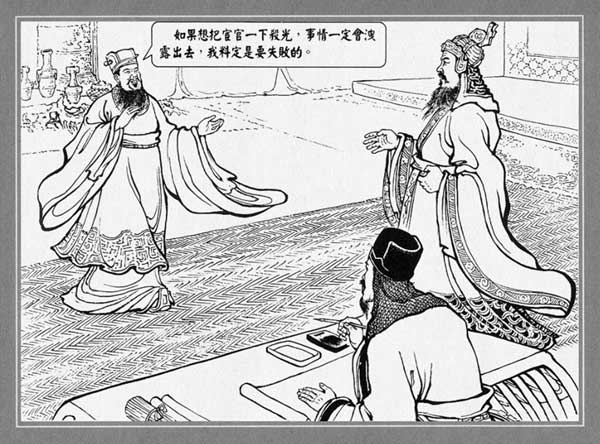
Dong
Zhuo was born in the far northwest at Lintao in the West Valley Land. As the
Governor of Hedong, Dong Zhuo himself was arrogant and overbearing. But the day
he had treated Liu Bei with contumely had been his last, had not Liu Bei and
Guan Yu restrained their wrathful brother Zhang Fei.
"Remember he has the government commission," said Liu Bei.
"Who are we to judge and slay?"
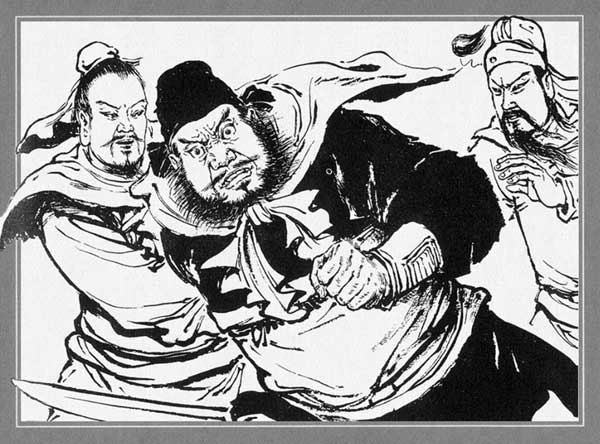
"It
is bitter to take orders from such a wretch. I would rather slay him! You may
stay here if you wish to, but I will seek some other place," said Zhang
Fei.
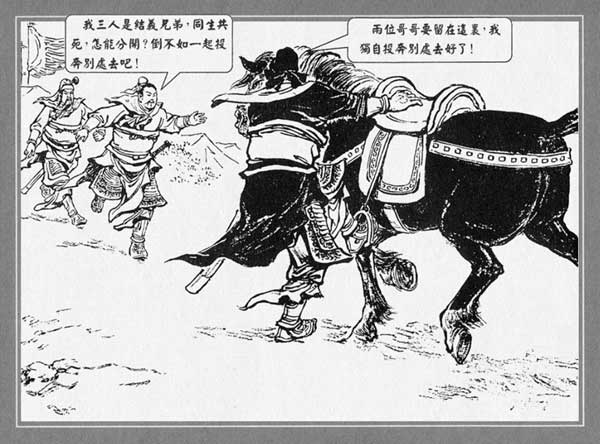
"We three are one in life and in death; there is no parting for us.
We will all go hence."
So spoke Liu Bei, and his
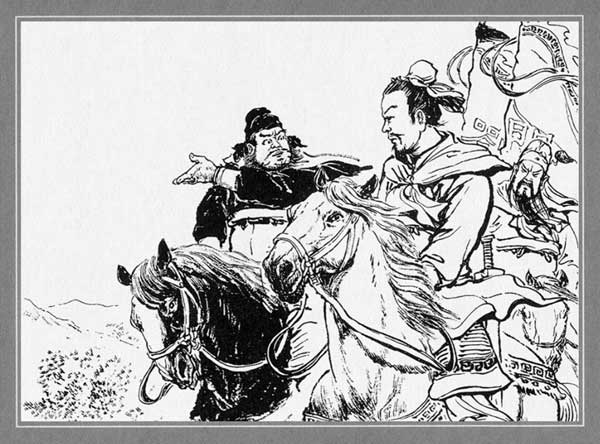
brother was satisfied. Wherefore all three set out and lost no time in
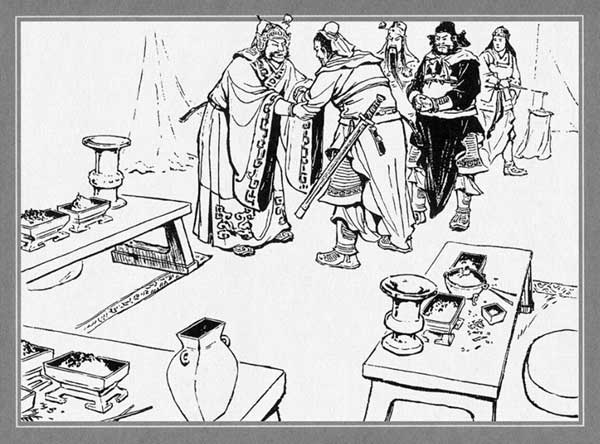
traveling until they came to Zhu Jun, who received them well and accepted their
aid in attacking Zhang Ba.
At
this time Cao Cao had joined himself to Huangfu Song, and they were trying to
destroy Zhang Lian, and there was a great battle at Quyang.
Zhang
Ba was commanding some eighty thousand troops. The rebel had led his army to a
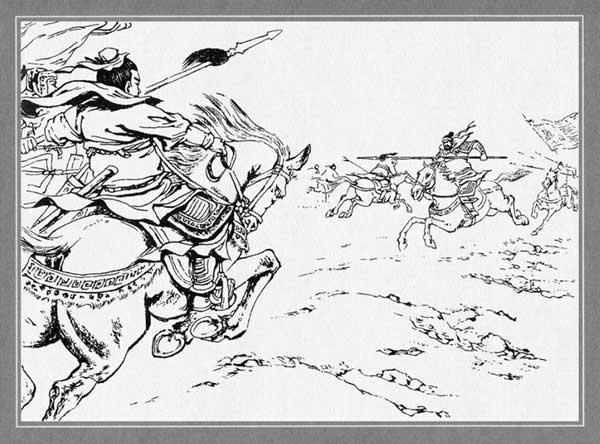
strong position in the rear of the hills. An attack being decided upon, Liu Bei
was the van leader. On the rebel side a general of Zhang Ba, Gao Sheng, came
out to offer battle.
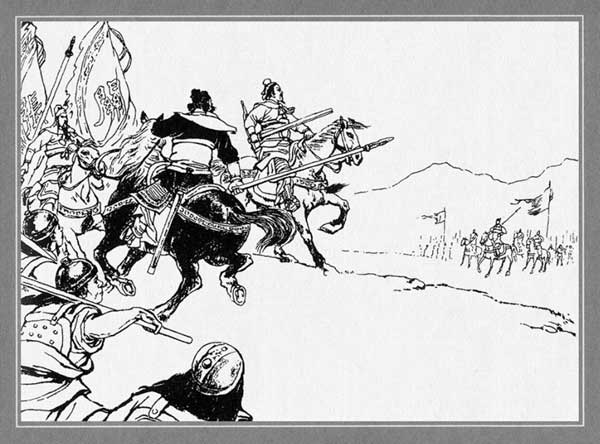
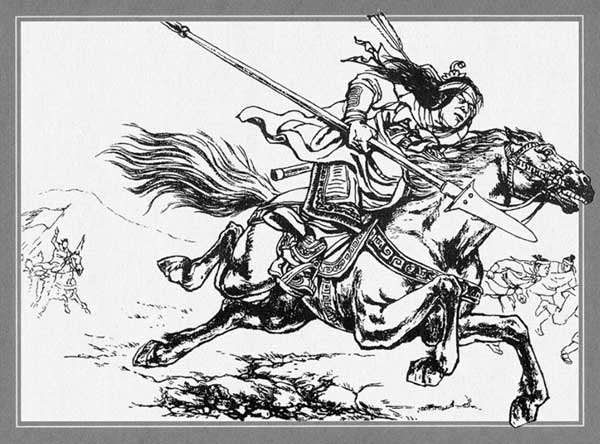
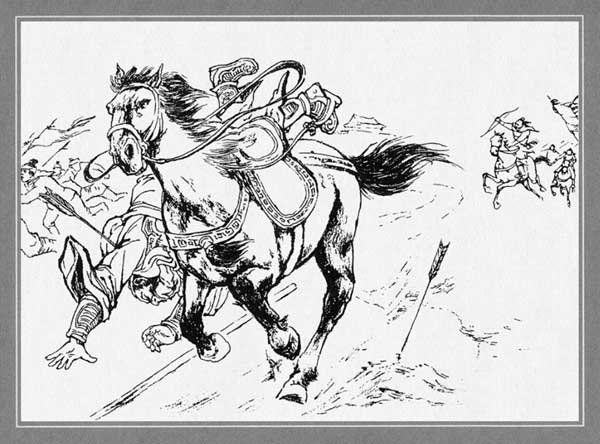
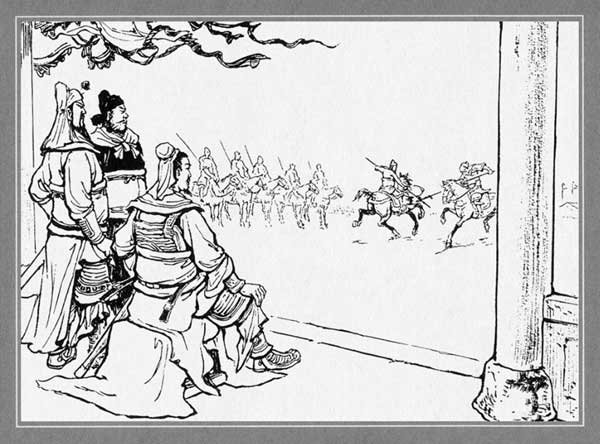
Liu Bei sent Zhang Fei to
smite Gao Sheng. Out rode Zhang Fei at full speed, his spear ready set. After a
few bouts Zhang Fei wounded Gao Sheng, who was unhorsed.
At
this Liu Bei signaled the main army to advance.
Then Zhang Ba, while still mounted, loosened his hair, grasped his
sword, and uttered his incantations. Thereupon began the wind to howl and the
thunder to roll, while a dense black cloud from the heavens settled upon the
field. And therein seemed to be horsemen and footmen innumerable, who swept to
attack the imperial troops. Fear came upon them, and Liu Bei led off his
troops, but they were in disorder and returned defeated.
Zhu
Jun and Liu Bei considered the matter.
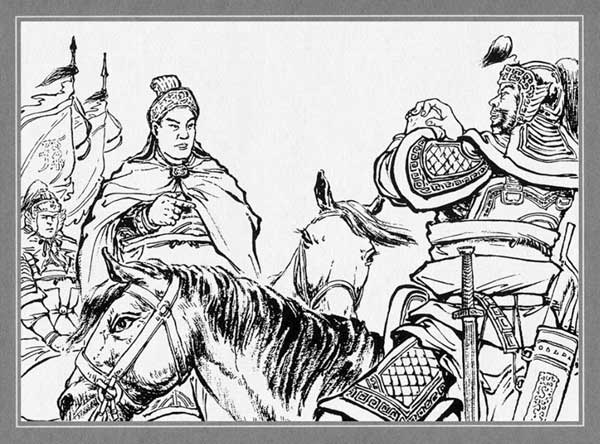
"Zhang
Ba uses magic," said Zhu Jun. "Tomorrow, then, will I prepare counter
magic in the shape of the blood of slaughtered swine and goats. This blood
shall be sprinkled upon their hosts from the precipices above by soldiers in
ambush. Thus shall we be able to break the power of their shamanic art."
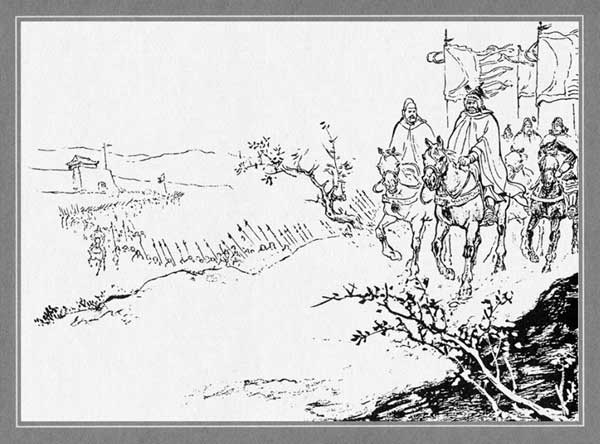
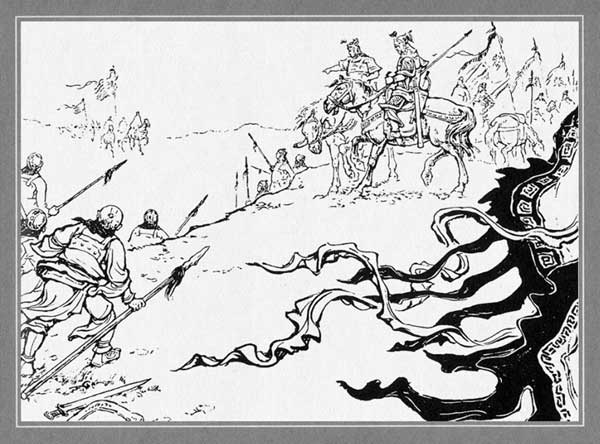
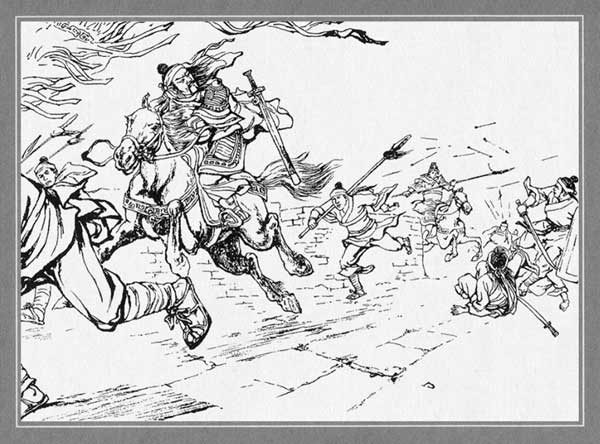
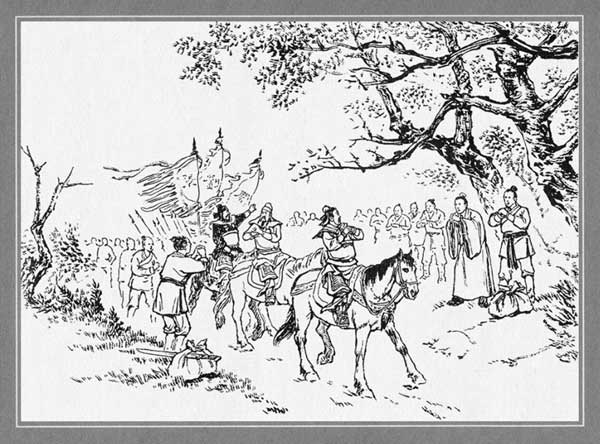
So it was done. Guan Yu and Zhang Fei took each a thousand troops and
hid them on the high cliffs behind the hills, and they had a plentiful supply
of the blood of swine and goats and all manners of filthy things. And so next
day, when the rebels with fluttering banners and rolling drums came out to
challenge, Liu Bei rode forth to meet them. At the same moment that the armies
met, again Zhang Ba began his magic and again the elements began to struggle
together. Sand flew in clouds, pebbles were swept along the ground, black
masses of vapor filled the sky, and rolling masses of foot and horse descended
from on high. Liu Bei turned, as before, to flee and the rebels rushed on.
 |
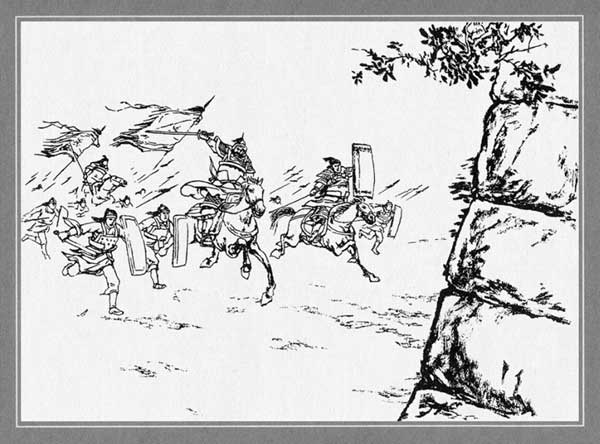
But
as they pressed through the hills, the trumpets blared, and the hidden soldiers
exploded bombs, threw down filth and spattered blood. The masses of soldiers
and horses in the air fluttered to the earth as fragments of torn paper, the
wind ceased to blow, the thunder subsided, the sand sank, and the pebbles lay
still upon the ground.
Zhang
Ba quickly saw his magic had been countered and turned to retire. Then he was
attacked on the flanks by Guan Yu and Zhang Fei, and in rear by Liu Bei and Zhu
Jun.
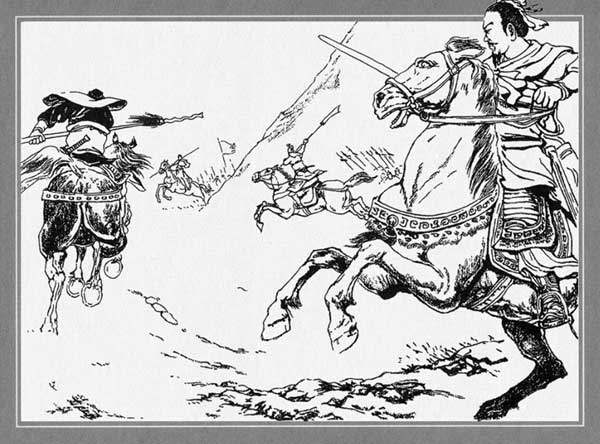
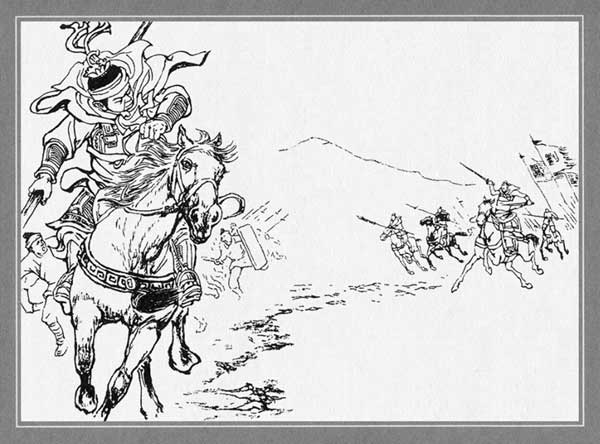
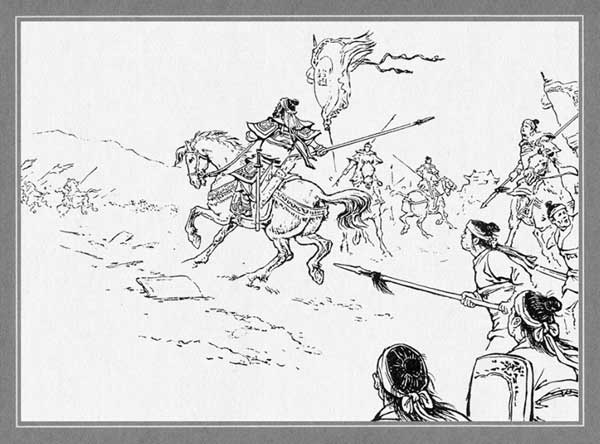
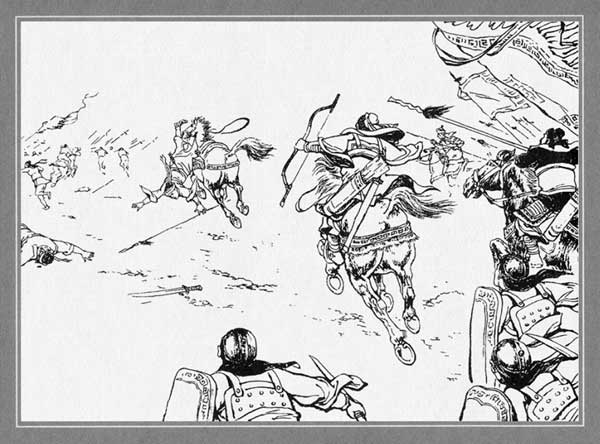
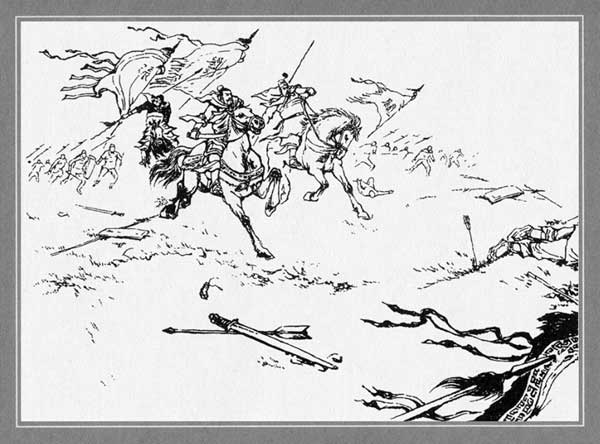
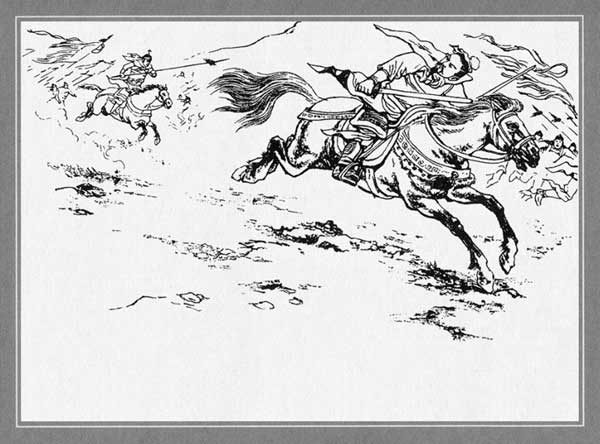
The rebels were routed. Liu
Bei, seeing from afar the banner of Zhang Ba The Lord of Earth, galloped toward
it but only succeeded in wounding Zhang Ba with an arrow in the left arm.
Wounded
though he was, Zhang Ba got away into the city of Yangcheng, where he fortified
himself and was besieged by Zhu Jun.
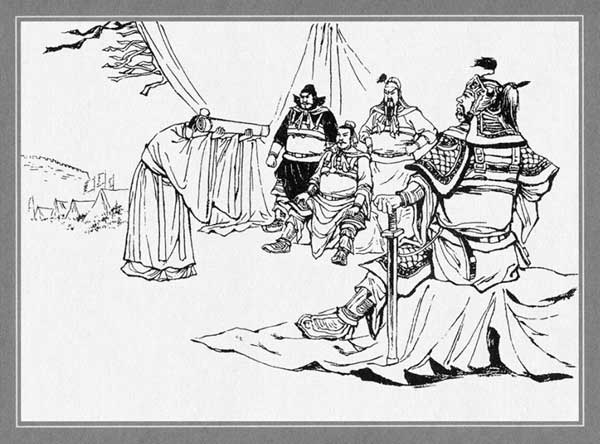
Scouts,
sent out to get news of Huangfu Song, reported: "Commander Huangfu Song
had been very successful, and Dong Zhuo had suffered many reverses. Therefore
the court put Huangfu Song in the latter's place. Zhang Jue had died before
Huangfu Song's arrival. Zhang Lian had added his brother's army to his own, but
no headway could be made against Huangfu Song, whose army gained seven
successive victories. And Zhang Lian was slain at Quyang.
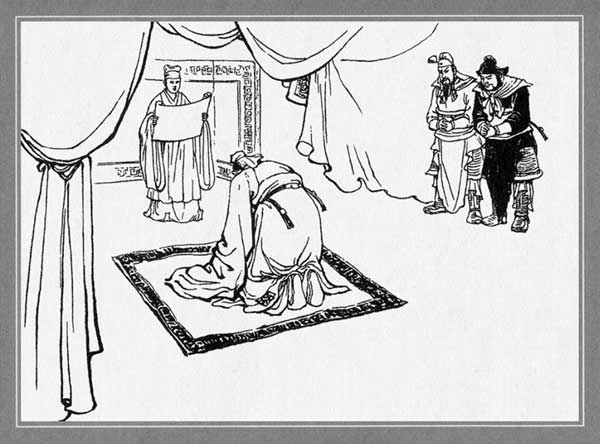
Beside this, Zhang Jue's
coffin was exhumed, the corpse beheaded, and the head, after exposure, was sent
to Capital Luoyang. The common crowd had surrendered. For these services
Huangfu Song was promoted to General of the Flying Chariots and the Imperial
Protector of Jizhou.
"Huangfu Song did not
forget his friends. His first act after he had attained to power was to
memorialize the Throne concerning the case of Lu Zhi, who was then restored to
his former rank for his meritorious conduct. Cao Cao also received advancement
for his services and is preparing to go to Jinan to his new post."
Hearing
these things Zhu Jun pressed harder yet upon Yangcheng, and the approaching
break-up of the rebellion became evident.
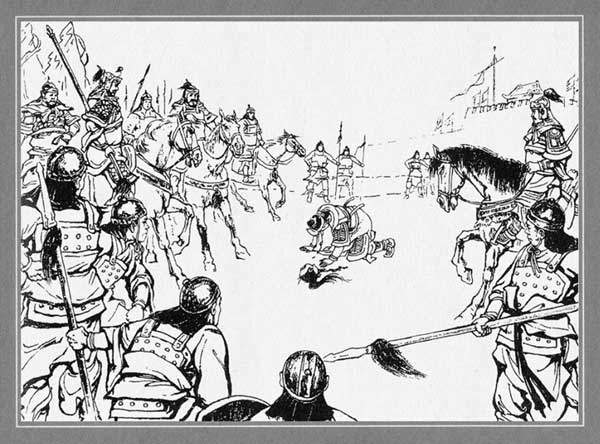
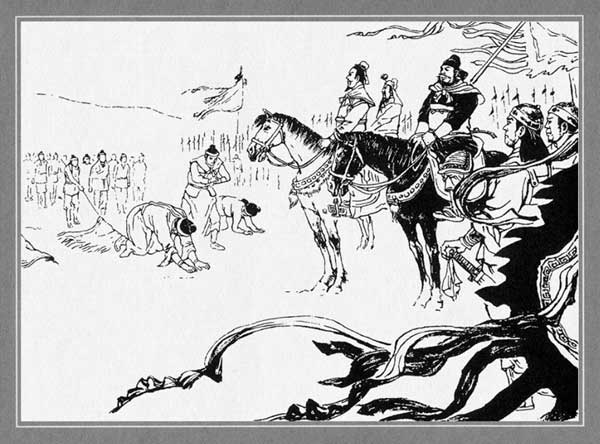
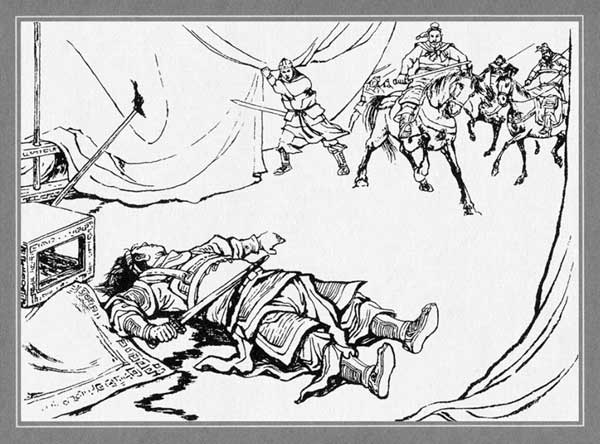
Then
one of Zhang Ba's officers, Yan Zheng, killed his leader and brought the head
in token of submission.
Thus
rebellion in that part of the country was stamped out, and Zhu Jun made his
report to the government.
However,
the embers of the Yellow Scarves still smoldered. Three other rebels, Zhao
Hong, Han Zhong, and Sun Zhong, gathered some thirty thousand rebels and began
to murder and rob and burn, calling themselves the avengers of Master Zhang
Jue.
The court commanded the successful Zhu Jun to lead his veteran and
successful troops to destroy the rebels. He at once marched toward the city of
Wancheng which the rebels were holding.
When Zhu Jun arrived, Han
Zhong went to oppose him. Zhu Jun sent Liu Bei and his brothers to attack the
southwest corner of the city. Han Zhong at once led the best of his troops to
defend the city. Meanwhile Zhu Jun himself led two thousand of armored horsemen
to attack the opposite corner. The rebels, thinking the city being lost,
abandoned the southwest and turned back into the city to help the defenders.
Liu Bei pressed hotly in their rear, and they were utterly routed. They took
refuge in the city which was then invested. When famine pressed upon the
besieged, they sent a messenger to offer to surrender, but Zhu Jun refused the
offer.
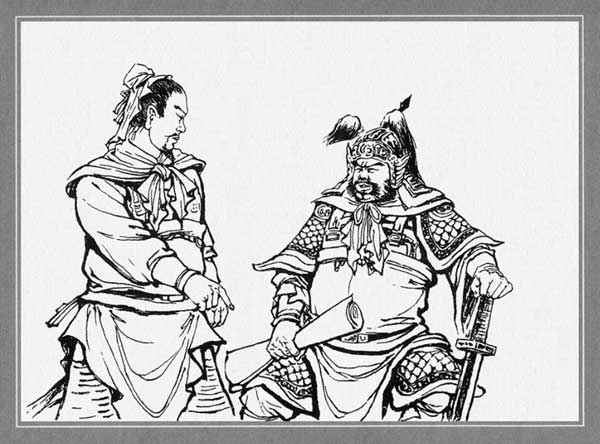
Said
Liu Bei to Zhu Jun, "Seeing that the founder of the Han Dynasty, Liu Bang
the Supreme Ancestor, could welcome the submissive and receive the favorable,
why reject these?"
"The
conditions are different," replied Zhu Jun. "In those old days
disorder was universal and the people had no fixed lord. Wherefore submission
was welcomed and support rewarded to encourage people to come over. Now the
empire is united, and the Yellow Scarves are the only malcontents. To receive
their surrender is not to encourage the good. To allow brigands, when
successful, is to give way to every license, and to let them surrender when
they fail is to encourage brigandage. Your plan is not a good one."
Liu
Bei replied, "Not to let brigands surrender is well. But the city is
surrounded as by an iron barrel. If the rebels' request be refused, they will
be desperate and fight to the death, and we can hardly withstand a myriad of
such men. Moreover, in the city there are many times that number, all doomed to
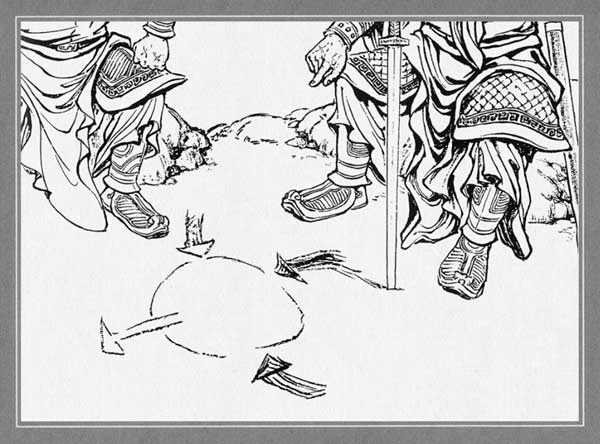
death. Let us withdraw from one corner and only attack the opposite. They will
all assuredly flee and have no desire to fight. We shall take them."
Zhu Jun saw that the advice
was good and followed it. As predicted the rebels ran out, led by Han Zhong.
The
besiegers fell upon them as they fled, and Han Zhong was slain. The rebels
scattered in all directions.
But the other two rebel
chieftains, Zhao Hong and Sun Zhong, came with large reinforcements, and as
they appeared very strong, the imperial soldiers retired, and the new body of
rebels reentered Wancheng.
Zhu Jun encamped three miles
from the city and prepared to attack.
Just then there arrived a
body of horse and foot from the east. At the lead was one general with a broad
open face, a body as an alert tiger's, and a torso as a lofty bear's.
His name was Sun Jian. He
was a native of Fuchun in the old state of Wu, a descendant of the famous Sun
Zi the Strategist.
When
he was seventeen, Sun Jian was with his father on the River Qiantang and saw a
party of pirates, who had been plundering a merchant, dividing their booty on
the river bank.
"We
can capture these!" said he to his father.
So,
gripping his sword, he ran boldly up the bank and cried out to this side and
that as if he was calling his men to come on. This made the pirates believe the
soldiers were on them and they fled, leaving their booty behind them. He
actually killed one of the pirates. In this way be became known and was
recommended for office.
Then,
in collaboration with the local officials, he raised a band of one thousand and
helped to quell the rebellion of one Xu Chang, who called himself the Sun
Emperor and had ten thousand supporters. The rebel's son Xu Hao was also slain
with his father. For this Sun Jian was commended by Imperial Protector Zang Min
in a memorial to the Throne, and he received further promotion to the post of
magistrate of Yandu, then of Xuyi, and then of Xiapi.
When
the Yellow Scarves rebellion began, Sun Jian gathered together the youths of
his village, some of the merchant class, got a troop of one thousand five
hundred of veteran soldiers and took the field. Now he had reached the fighting
area.
Zhu
Jun welcomed Sun Jian gladly and ordered him to attack the south gate of
Wancheng. The north and the west gates were simultaneously attacked by Liu Bei
and Zhu Jun, but the east gate was left free to give the rebels a chance of
exit.
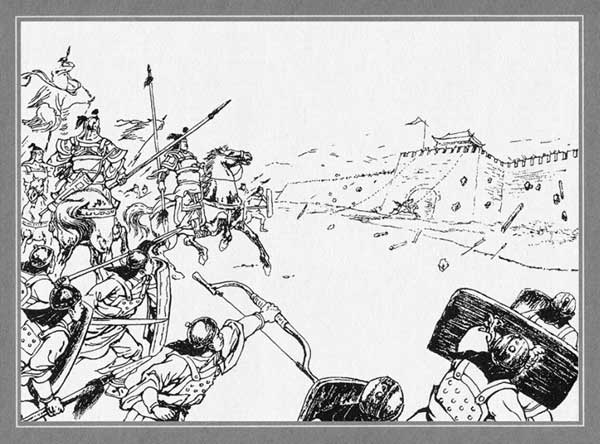
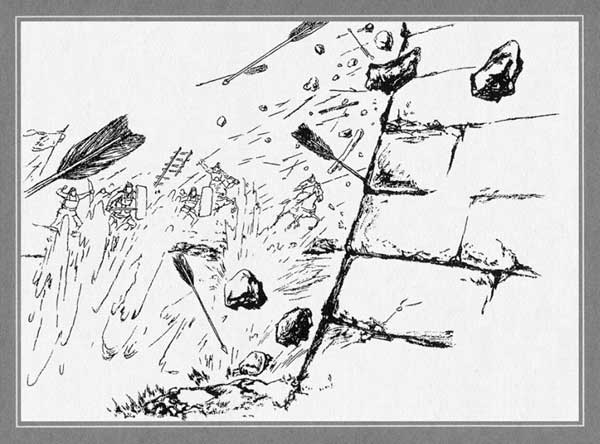
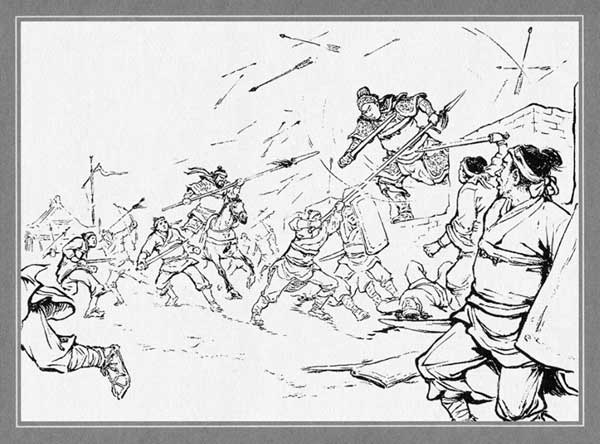
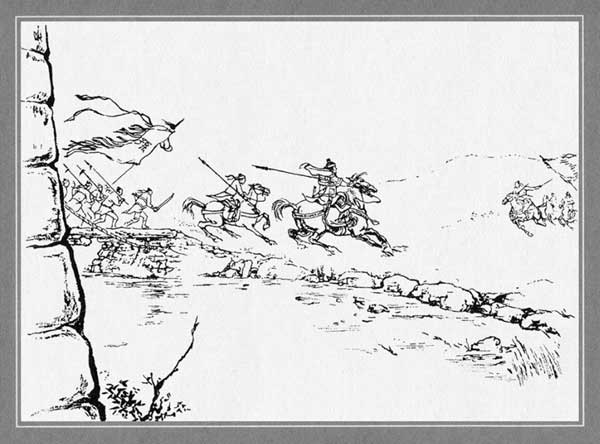
Sun Jian was the first to
mount the wall and cut down more than twenty rebels with his own sword.
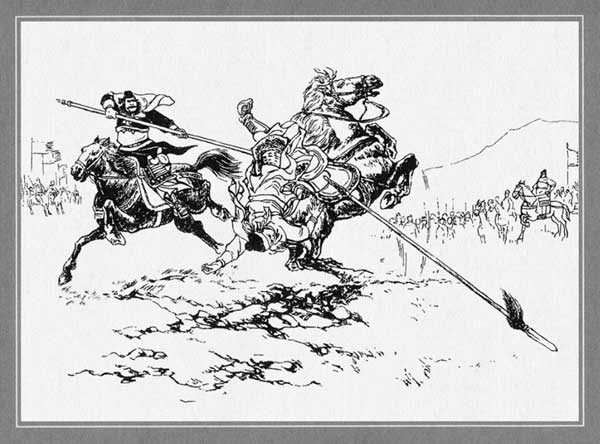
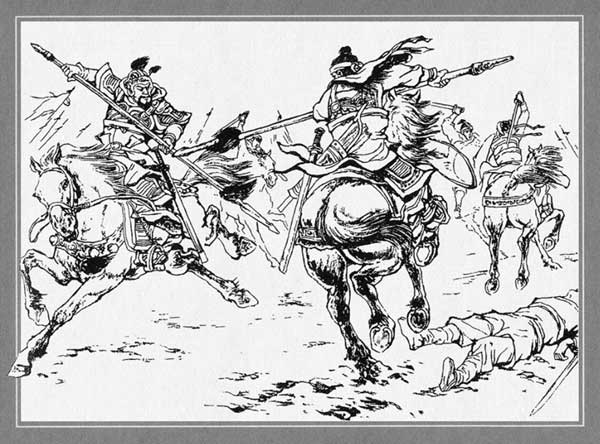
The rebels ran, but the
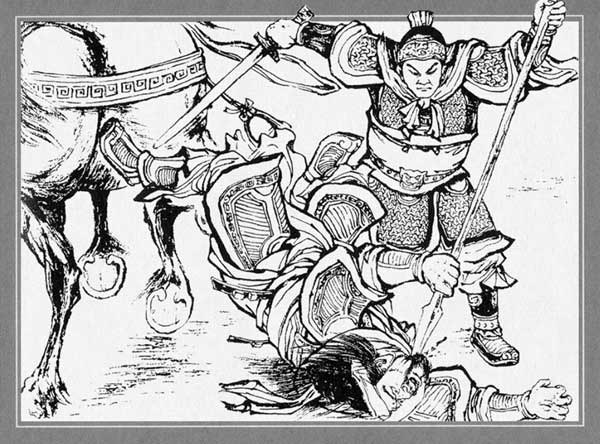
leader Zhao Hong rode directly at Sun Jian with his spear ready to thrust. Sun
Jian leaped down from the wall, snatched away the spear and with it knocked
Zhao Hong from the horse. Then Sun Jian, mounting Zhao Hong's horse, rode
hither and thither, slaying as he went.
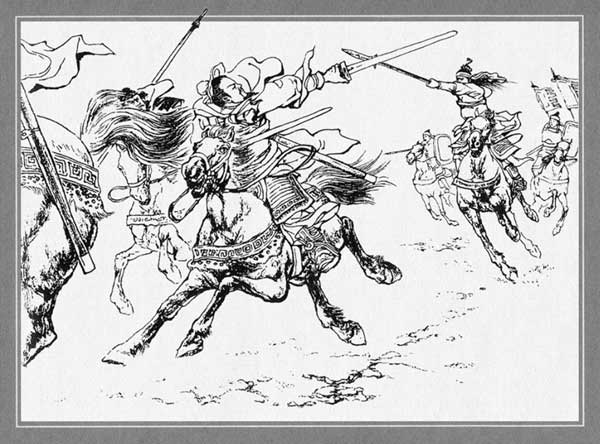
The
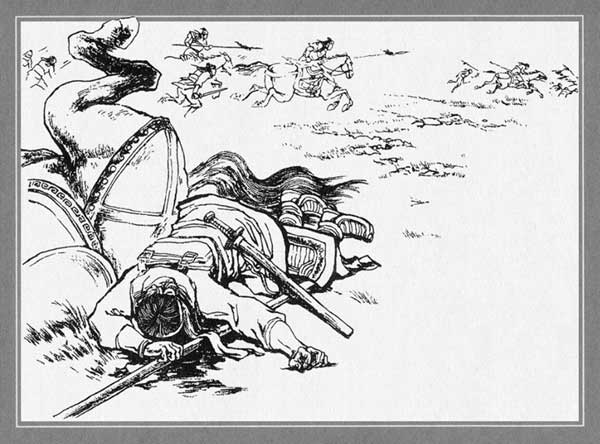
rebels fled north. Meeting Liu Bei, they declined to fight and scattered.
But Liu Bei drew his bow,
fitted an arrow, and shot their leader Sun Zhong, who fell to the ground. The
main army of Zhu Jun came up, and after tremendous slaughter, the rebels
surrendered. Thus was peace brought to the ten counties about the Nanyang area.
Zhu
Jun returned to Capital Luoyang, was promoted to the General of the Flying
Cavalry, and received the governorship of Henan. He did not forget those who
had helped him to win victory. Thus he reported the merits of Liu Bei and Sun
Jian to the Throne.
Sun
Jian, having influential friends and connections to support him, quickly got an
appointment to a post of Commander of Changsha and went to assume the new
office.
But
Liu Bei, in spite of Zhu Jun's memorial, waited in vain for preferment, and the
three brothers became very sad.
Walking
along one day in the capital, Liu Bei met a court official, Zhang Jun, to whom
he related his services and told his sorrows.
Zhang
Jun was much surprised at this neglect and one day at court spoke to the
Emperor about it.
Said he, "The Yellow Scarves rebelled because the eunuchs sold
offices and bartered ranks. There was employment only for their friends,
punishment only for their enemies. This led to rebellion. Wherefore it would be
well to slay the Ten Eunuchs and expose their heads and proclaim what had been
done throughout the whole empire. Then reward the worthy. Thereby the land
would be wholly tranquil."
But the eunuchs fiercely
opposed this and said Zhang Jun was insulting the Emperor, and the Emperor bade
the guards thrust Zhang Jun out.
However,
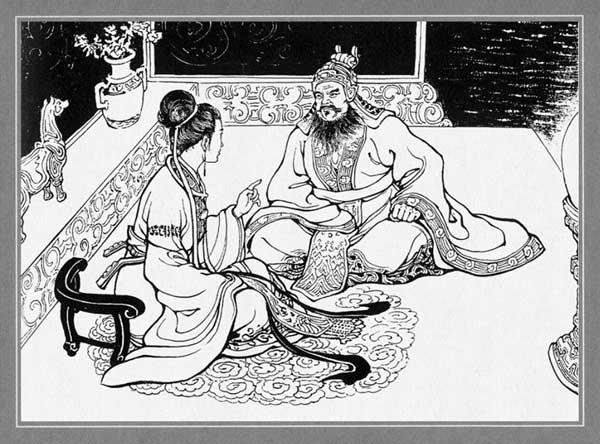
the eunuchs took counsel together and one said, "Surely someone who
rendered some service against rebels resents being passed over."
So they caused a list of unimportant people to be prepared for
preferment by and by.
Among them was Liu Bei, who
received the post of magistrate of the county of Anxi, to which he proceeded
without delay after disbanding his army and sending them home to their
villages.
He
retained two dozens or so as escort.
The three brothers reached Anxi, and soon the administration of the
county was so reformed and the rule so wise that in a month there was no
law-breaking. The three brothers lived in harmony, eating at the same table and
sleeping on the same couch.
But
when Liu Bei was in public sessions or in company of others, Guan Yu and Zhang
Fei would stand in attendance, were it even a whole day.
Four
months after their arrival, there came out a general order for the reduction of
the number of military officers holding civil posts, and Liu Bei began to fear
that he would be among those thrown out.
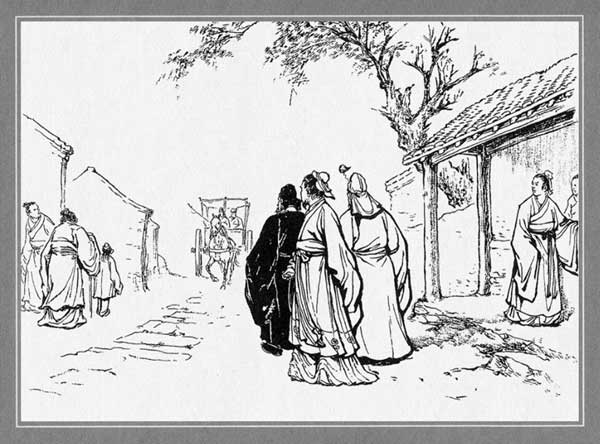
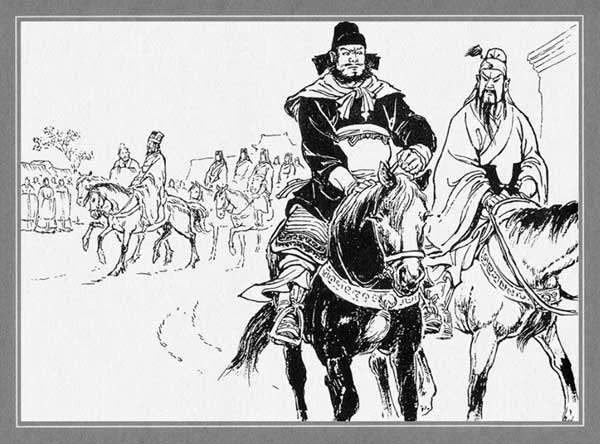
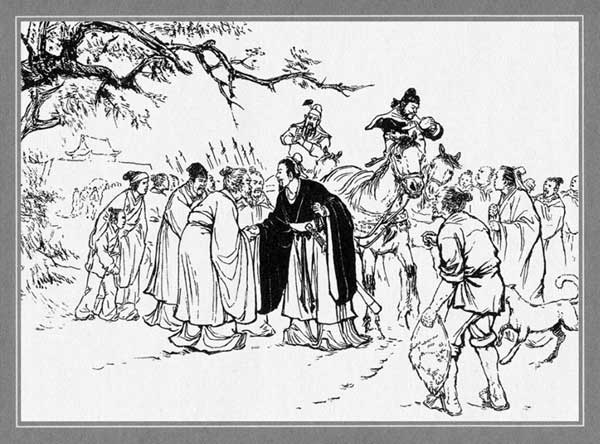
In
due course the inspecting official, Du Biao by name, arrived and was met at the
boundary.
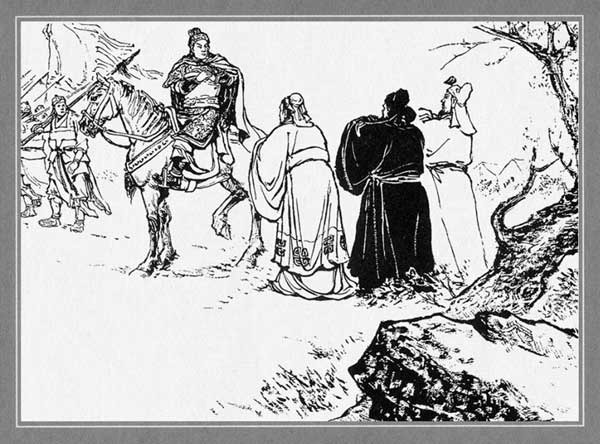
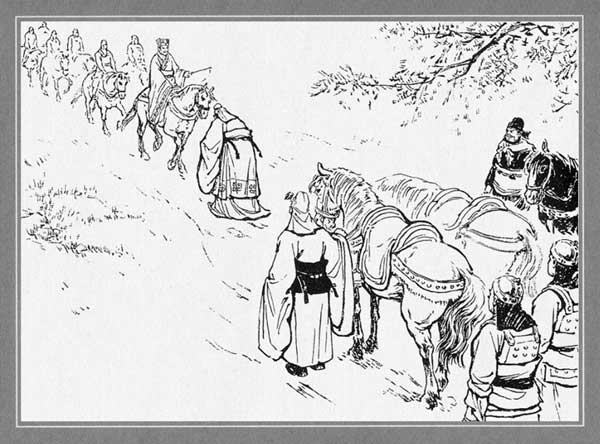
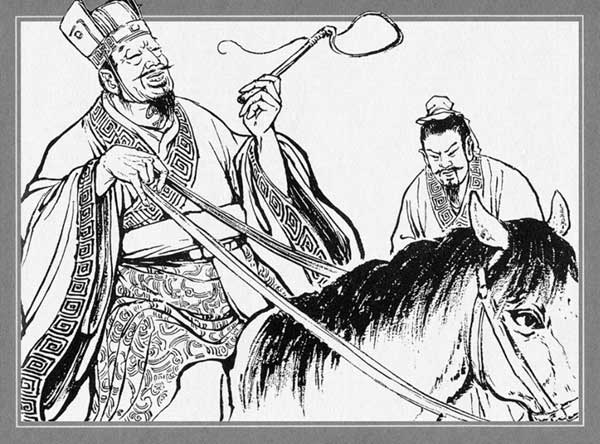
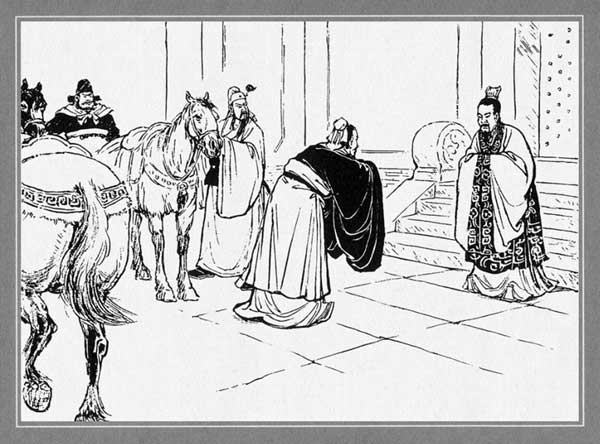
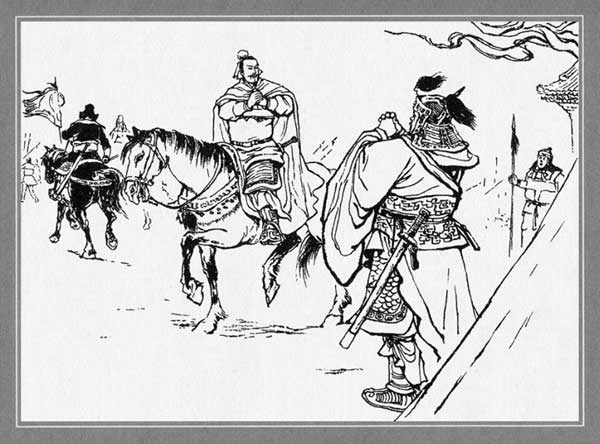
But to the polite obeisance
of Liu Bei, he made no return, save a wave of his whip as he sat on his horse.
This made Guan Yu and Zhang Fei furious. But worse was to
follow.
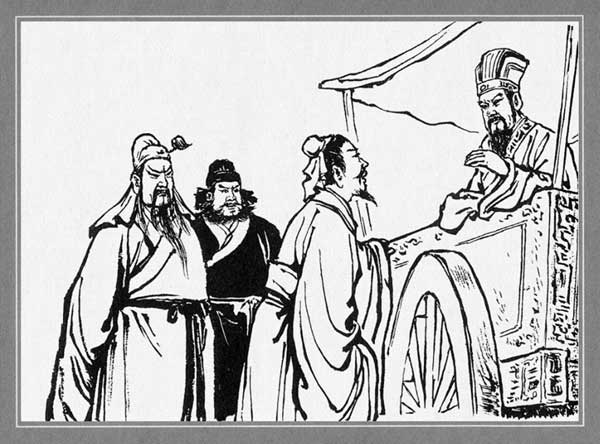
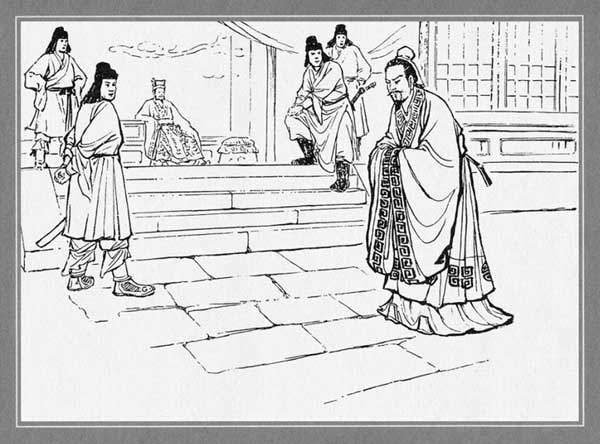
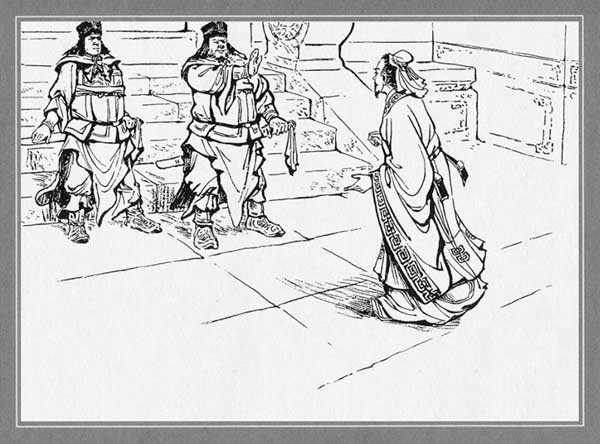
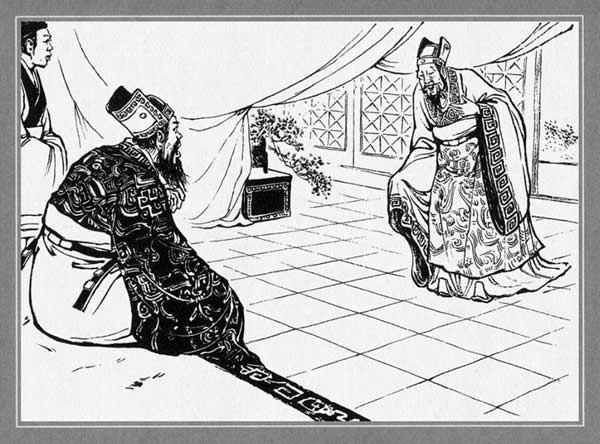
When
the inspector had arrived at his lodging, he took his seat on the dais, leaving
Liu Bei standing below.
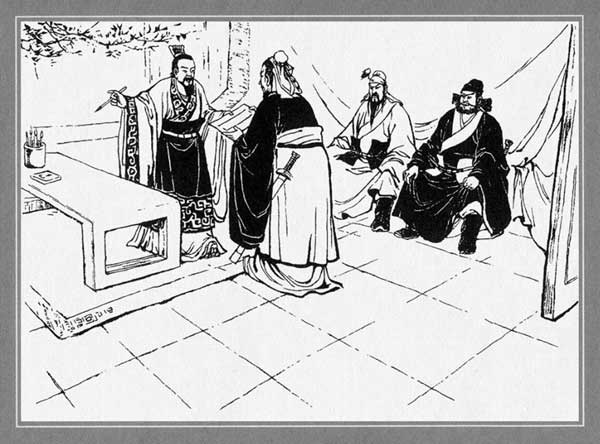
After
a long time he addressed Liu Bei.
"Magistrate,
what was your origin?"
Liu
Bei replied, "I am descended from Prince Sheng of Zhongshan. Since my
first fight with the Yellow Scarves rebels at Zhuo County, I have been in some
thirty battles, wherein I gained some trifling merit. My reward was this
office."
"You lie about your
descent, and your statement of services is false!" roared the inspector.
"Now the court has ordered the reduction of your sort of low class and
corrupt officials."
Liu
Bei muttered to himself and withdrew. On his return to the magistracy, he took
council with his secretaries.
"This
pompous attitude only means the inspector wants a bribe," said they.
"I
have never wronged the people to the value of a single coin: Then where is a
bribe to come from?"
Next day the inspector had the minor officials before him and forced
them to bear witness that their master had oppressed the people.
Liu
Bei time after time went to rebut this charge, but the doorkeepers drove him
away and he could not enter.
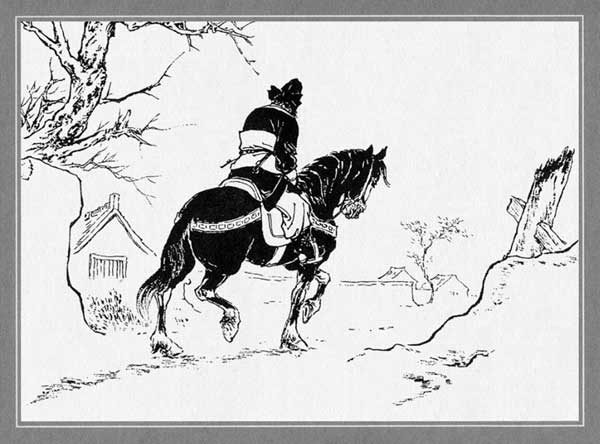
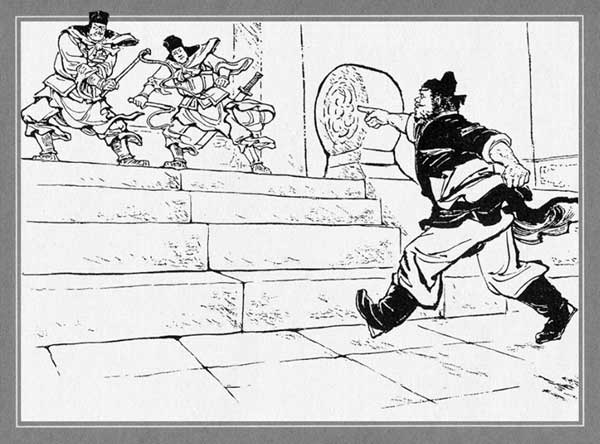
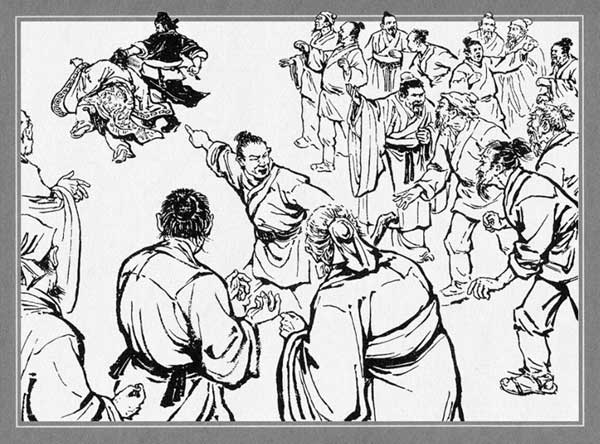
Now Zhang Fei had been all day drowning his sorrow in wine and had drunk
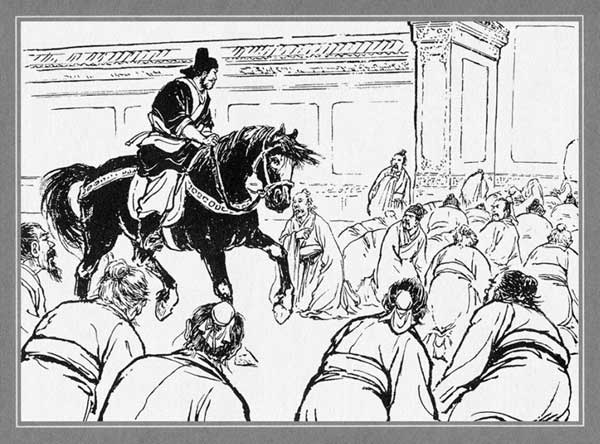
far too much. Calling for his horse he rode out past the lodging of the
inspector, and at the gate saw a small crowd of white-haired people weeping
bitterly. He asked why.
They said, "The
inspector has compelled the underlings to bear false witness against our
magistrate, with the desire to injure the virtuous Liu Bei. We came to beg
mercy for him but are not permitted to enter. Moreover, we have been beaten by
the doorkeepers."
But before the inspector
could reply, Zhang Fei had had him by the hair and had dragged him down.
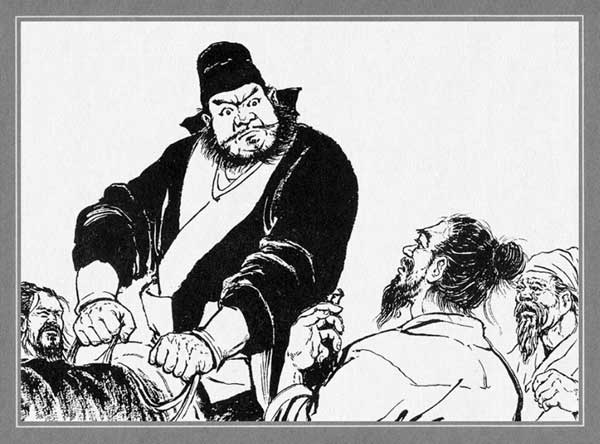
This
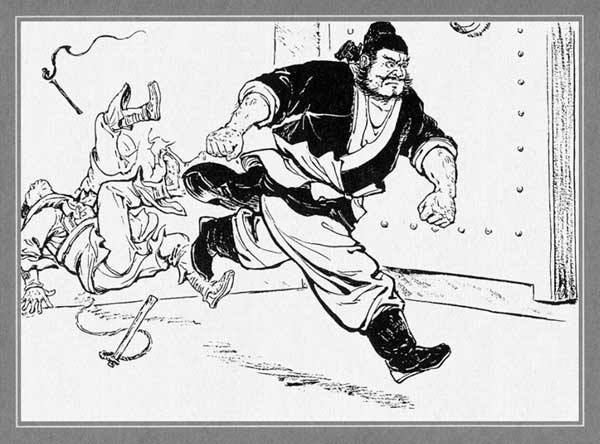
provoked the irascible and half intoxicated Zhang Fei to fury. His eyes opened
wide until they became circles; he ground his teeth; in a moment he was off his
steed, had forced his way past the scared doorkeepers into the building, and
was in the rear apartments.
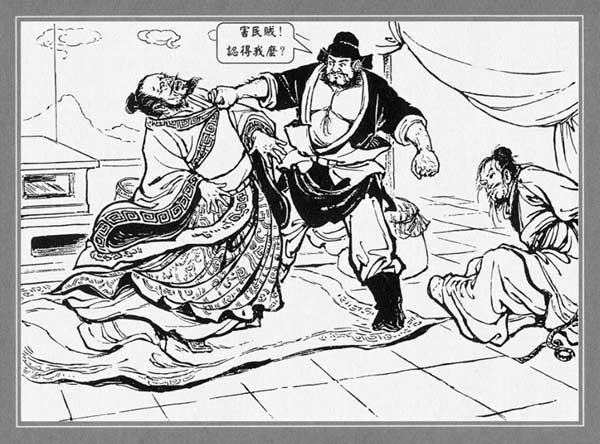
There
he saw Imperial Inspector Du Biao sitting on high with the official underlings
in bonds at his feet.
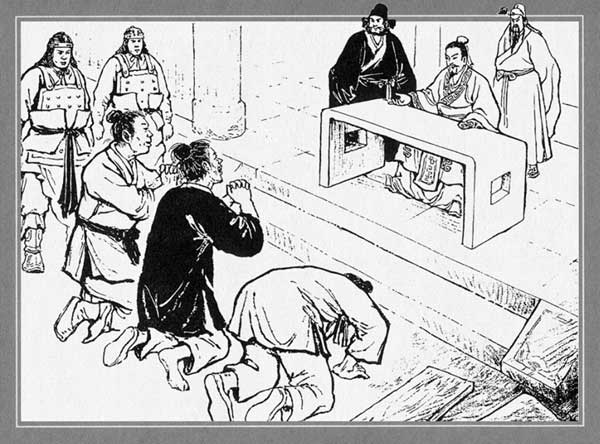
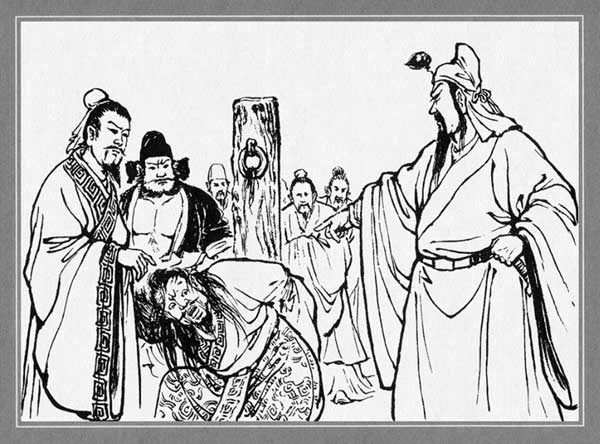
"Oppressor
of the people, robber!" cried Zhang Fei. "Do you know me?"
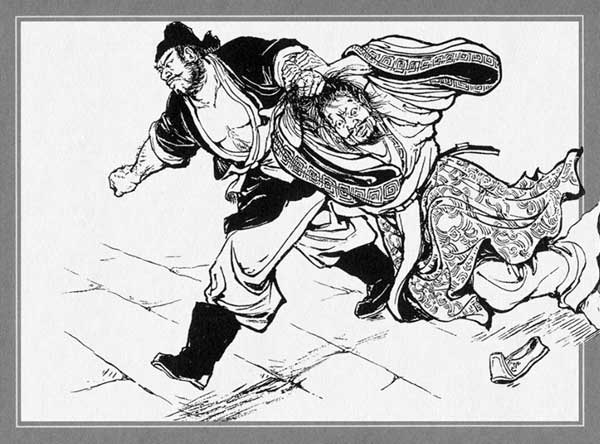
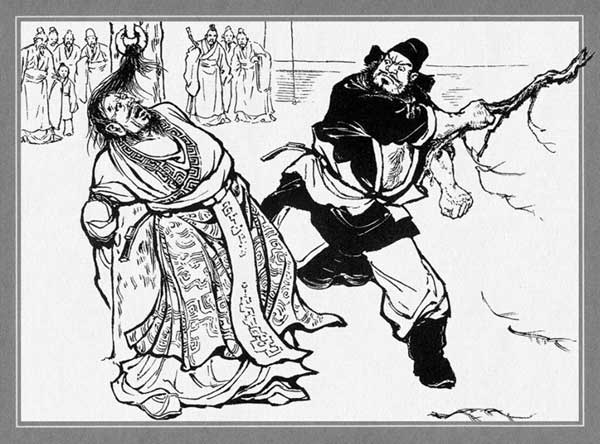
But
before the inspector could reply, Zhang Fei had had him by the hair and had
dragged him down.
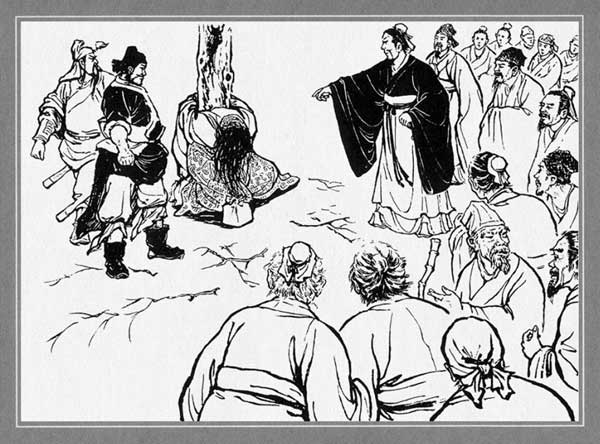
Another moment he was
outside and firmly lashed to the hitching post in front of the building.
Then
breaking off a switch from a willow tree, Zhang Fei gave his victim a severe
thrashing, only staying his hand when the tenth switch was too short to strike
with.
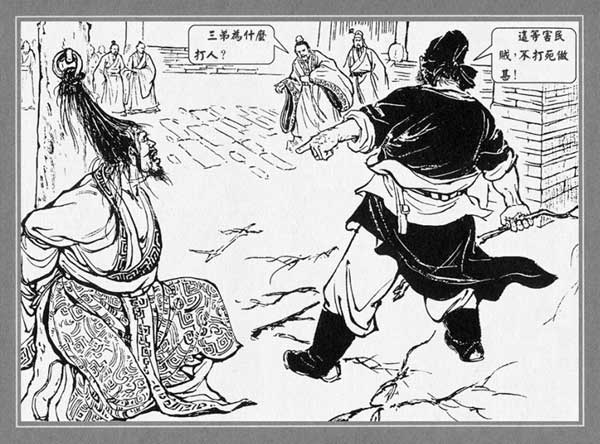
Liu
Bei was sitting alone, communing with his sorrow, when he heard a shouting
before his door. He asked what the matter was.
They
told him, "General Zhang Fei had bound somebody to a post and was
thrashing him!"
Hastily going outside, Liu Bei saw who the unhappy victim was and asked
Zhang Fei the reason.
"If
we do not beat this sort of wretch to death, what may we expect?" said
Zhang Fei.
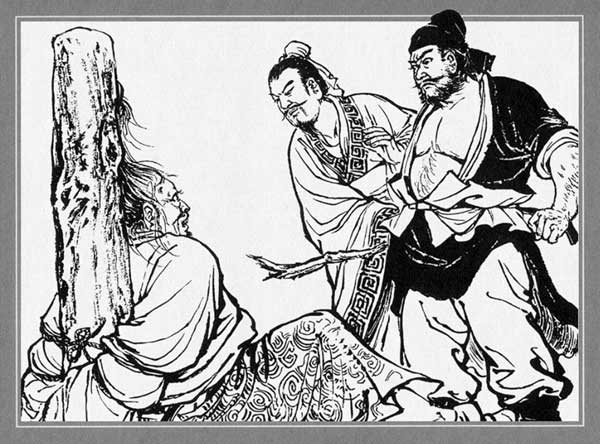
"Noble
Sir, save me!" cried the inspector.
Now Liu Bei had always been kindly and gracious, wherefore he bade his
brother release the officer and go his way.
Then
Guan Yu came up, saying, "Brother, after your magnificent services you
only got this petty post, and even here you have been insulted by this fellow.
A thorn bush is no place for a phoenix. Let us slay this fellow, leave here,
and go home till we can evolve a bigger scheme."
Liu
Bei contented himself with hanging the official seal about the inspector's
neck, saying, "If I hear that you injure the people, I will assuredly kill
you. I now spare your life, and I return to you the seal. We are going."
The
inspector went to the Governor of Dingzhou and complained, and orders were
issued for the arrest of the brothers, but they got away to Daizhou and sought
refuge with Liu Hu, who sheltered them because of Liu Bei's noble birth.
By
this time the Ten Regular Attendants had everything in their hands, and they
put to death all who did not stand in with them. From every officer who had
helped to put down the rebels they demanded presents; and if these were not
forthcoming, he was removed from office. Imperial Commanders Huangfu Song and
Zhu Jun both fell victims to these intrigues and were deprived from offices,
while on the other hand the eunuchs received the highest honors and rewards.
Thirteen eunuchs were ennobled, including Zhao Zhong who was added to the rank
of General of the Flying Cavalry. The government grew worse and worse, and
everyone was irritated.
Rebellions
broke out in Changsha led by Ou Xing, and in Yuyang led by Zhang Ju and Zhang
Chun. Memorials were sent up in number as snow flakes in winter, but the Ten
suppressed them all. One day the Emperor was at a feast in one of the gardens
with the Ten, when Court Counselor Liu Tao suddenly appeared showing very great
distress. The Emperor asked what the matter was.
"Sire,
how can you be feasting with these when the empire is at the last gasp?"
said Liu Tao.
"All
is well," said the Emperor. "Where is anything wrong?"
Said
Liu Tao, "Robbers swarm on all sides and plunder the cities. And all is
the fault of the Ten Eunuchs who sell offices and injure the people, oppress
loyal officials and deceive their superiors. All virtuous ones have left the
services and returned to their places. Misfortune is before our very
eyes!"
At
this the eunuchs pulled off their hats and threw themselves at their master's
feet.
"If
Minister Liu Tao disapproves of us," they said, "we are in danger. We
pray that our lives be spared and we may go to our farms. We yield our property
to help defray military expenses."
And
they wept bitterly.
The
Emperor turned angrily to Liu Tao, saying, "You also have servants: Why
can't you bear with mine?"
And
thereupon the Emperor called to the guards to eject Liu Tao and put him to
death.
Liu
Tao cried aloud, "My death matters nothing. The pity is that Han Dynasty,
after four centuries of reign, is falling fast!"
The
guards hustled him away and were just about to carry out the Emperor's order
when a minister stopped them, shouting, "Strike not! Wait till I have
spoken with His Majesty."
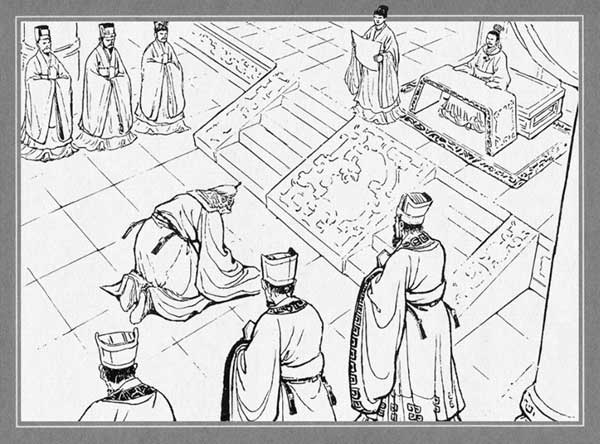
It
was the Minister of the Interior, Chen Dan. He went in to the Emperor, to whom
he said, "For what fault is Counselor Liu Tao to be put to death?"
"He
has vilified my servants and has insulted me," said the Emperor.
"All
the empire would eat the flesh of the eunuchs if they could, and yet, Sire, you
respect them as if they were your parents. They have no merit, but they are
created nobles. Moreover, Feng Xu was in league with the Yellow Scarves. Unless
Your Majesty looks to it, the state will crumble!"
"There
was no proof against Feng Xu," replied the Emperor. "About the Ten
Eunuchs, are there none faithful among them?"
Chen
Dan beat his forehead on the steps of the throne and did not desist from
remonstrance. Then the Emperor grew angry and commanded his removal and
imprisonment with Liu Tao. That night Liu Tao and Chen Dan were murdered.
Then
the eunuchs sent a forged edict to Sun Jian making him Governor of Changsha,
with orders to suppress the rebellion of Ou Xing. In less than two months Sun
Jian reported the county all tranquil. For this he was created Lord of Wucheng.
Further,
Liu Yu was made Imperial Protector of Youzhou to move against Yuyang and
suppress Zhang Ju and Zhang Chun. Liu Hu of Daizhou recommended Liu Bei to Liu
Yu.
Liu Yu welcomed Liu Bei and
gave him rank of Commander and sent him against the rebels. He fought with and
worsted them and entirely broke their spirit.
Zhang
Chun was cruel, and his leaders turned against him. One of his officers then
slew him and brought in his head, after which the others submitted.
The other leader Zhang Ju saw that all was lost and killed
himself.
Yuyang being now tranquil,
Liu Bei's services were reported to the Throne, and he received full pardon for
the insult to the imperial inspector. He was made Deputy Magistrate of Xiami,
then Commanding Officer of Gaotang. Then Gongsun Zan praised Liu Bei's former
services, and he was promoted to Magistrate of Pingyuan.
This place was very prosperous,
and Liu Bei recovered something of his old manner before the days of adversity.
Liu Yu also received preferment and was promoted to Grand Commander.
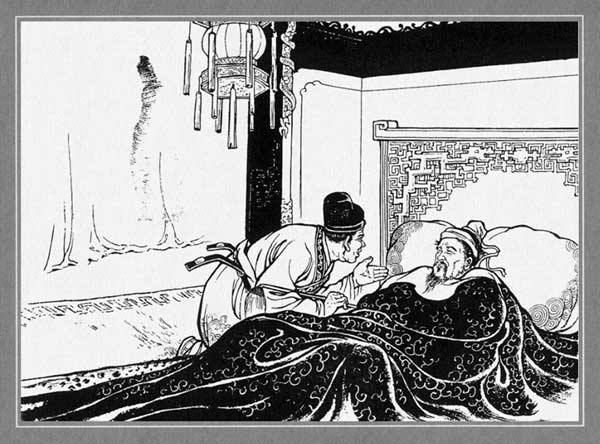
In
the summer of the six year of Central Stability (AD 189), Emperor Ling became
seriously ill and summoned He Jin into the Palace to arrange for the future. He
Jin had sprung from a humble family of butchers, but his sister had become a
concubine of rank and borne a son to the Emperor, named Liu Bian. After this
she became Empress He, and He Jin became the powerful Regent Marshal.
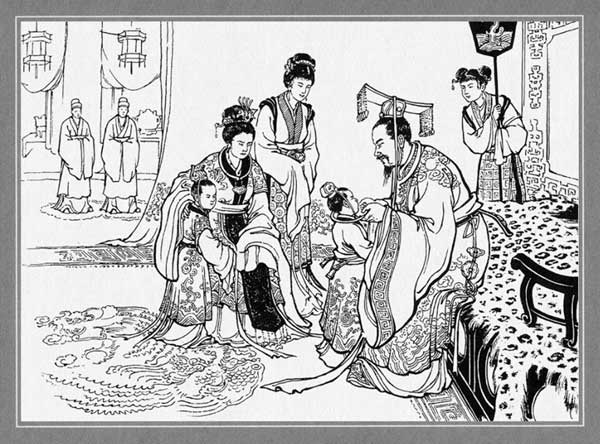
The
Emperor had also greatly loved a beautiful girl, Lady Wang, who had borne him a
son named Liu Xian. Empress He had poisoned Lady Wang from jealousy, and the
baby had been given into the care of Empress Dong, who was the mother of
Emperor Ling.
Lady
Dong was the wife of Liu Chang, Lord of Jiedu. As time went on and the Emperor
Huan had no son of his own, he adopted the son of Liu Chang, who succeeded as
the Emperor Ling. After his accession, Emperor Ling had taken his own mother
into the Palace to live and had conferred upon her the title of Empress
Dowager.
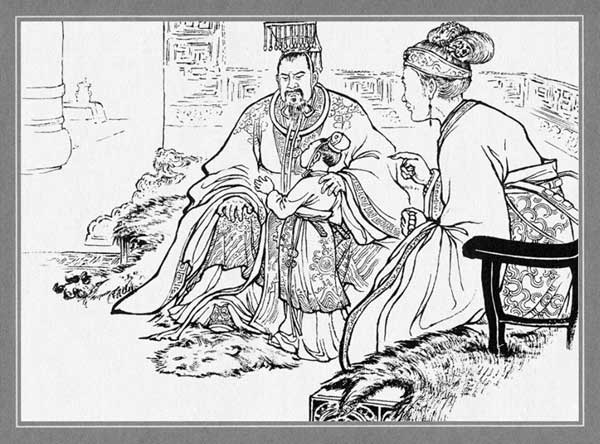
Empress
Dong had always tried to persuade her son to name Liu Xian as the Heir
Apparent, and in fact the Emperor greatly loved the boy and was disposed to do
as his mother desired.
When his end was near, one
of the eunuchs, Jian Shuo, said, "If Liu Xian is to succeed, He Jin must
be killed to prevent any countermeasure."
The Emperor saw this too.
And he summoned He Jin to come to him.
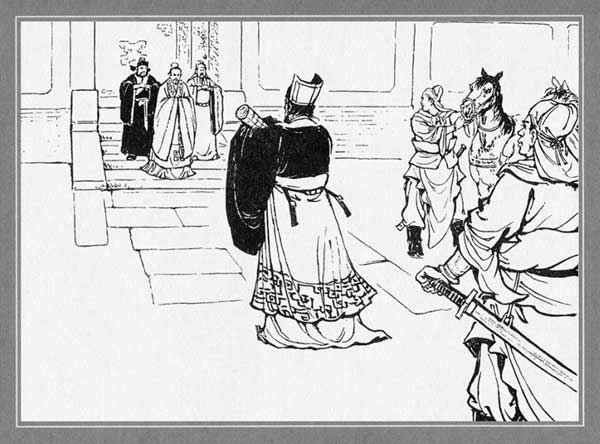
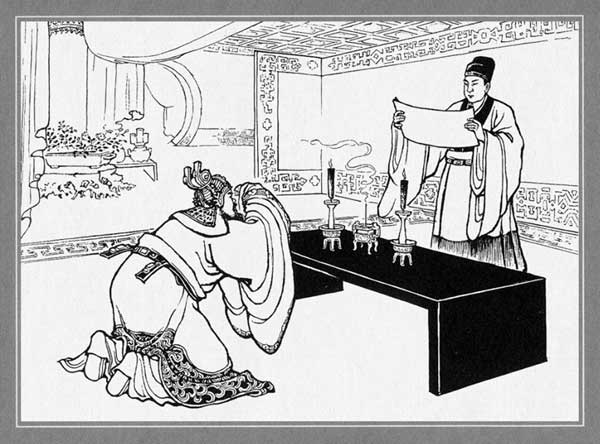
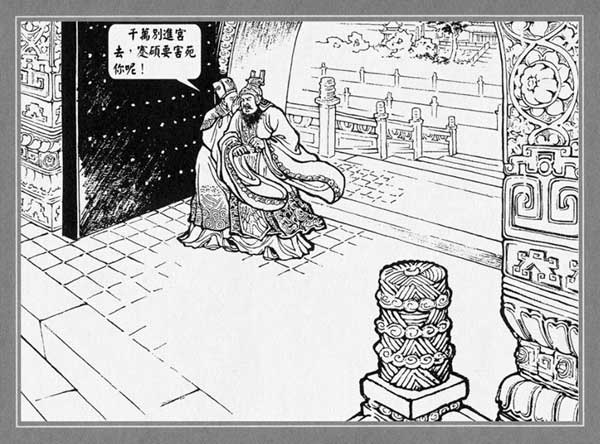
But at the very gate of the
Forbidden City, He Jin was warned of his danger by Commander Pan Yin who said,
"This must be a trap of Jian Shuo to destroy you!"
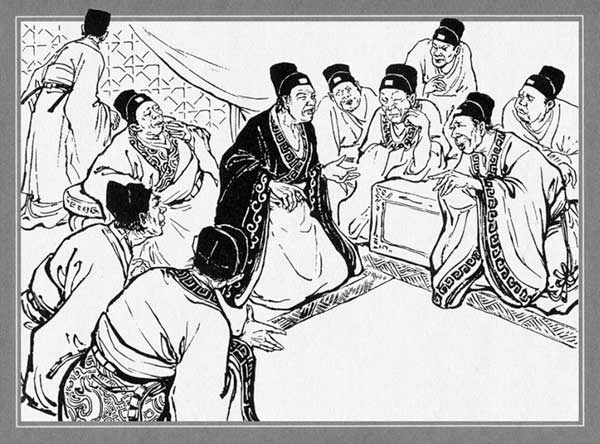
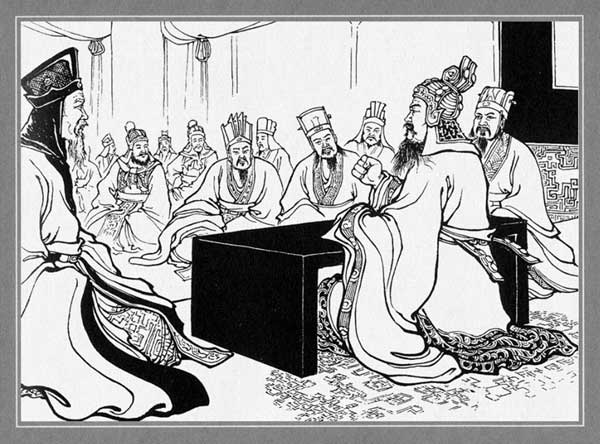
He
Jin rushed back to his quarters and called many of the ministers to his side,
and they met to consider how to put the eunuchs to death.
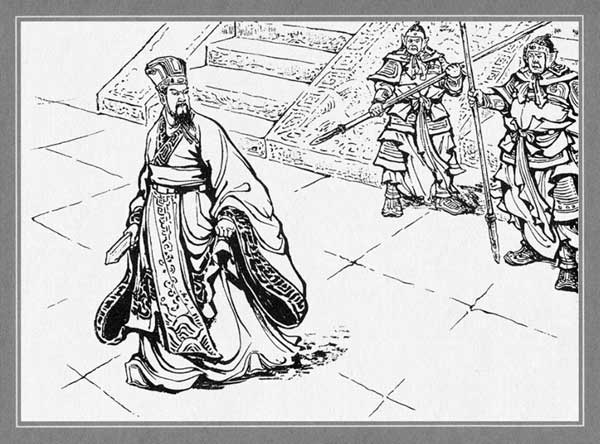
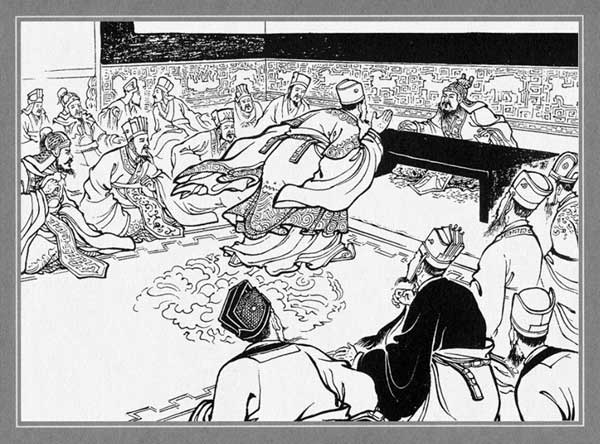
At this assembly a man
spoke against the plot, "The influence of the eunuchs dates back a century
and a half, during the reigns of Emperors Chong and Zhi. It has spread like a
noxious weed in all directions. How can we hope to destroy it? Above all keep
this plot secret, or our whole clans will be exterminated."
He
Jin eyed down and saw General of Military Standards Cao Cao.
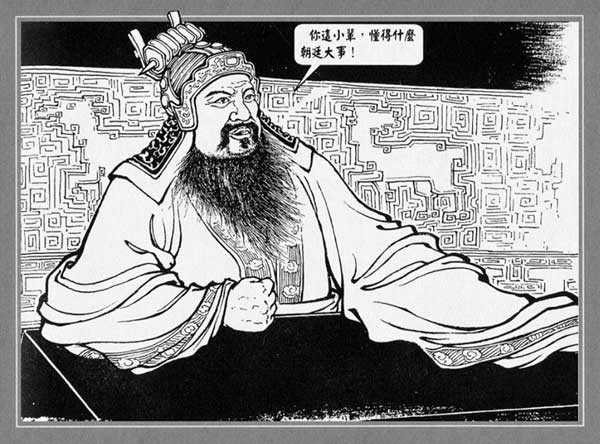
He Jin was very angry at this speech and cried, "What do inferiors
like you know of the ways of government?"
And
in the midst of the confusion Pan Yin came to say: "The Emperor is no
more. The eunuchs have decided to keep the death a secret and forge a command
to the Regent Marshal to come into the Palace to settle the succession.
Meanwhile to prevent trouble they have inscribed the name of Prince Xian on the
roll."
And
as Pan Yin finished speaking, the edict arrived summoning He Jin.
"The
matter for the moment is to set up the rightful heir," said Cao Cao.
"We can deal with the traitors later."
"Who
dare to join me in supporting the rightful heir---Prince Bian?" asked He
Jin, the Regent Marshal.
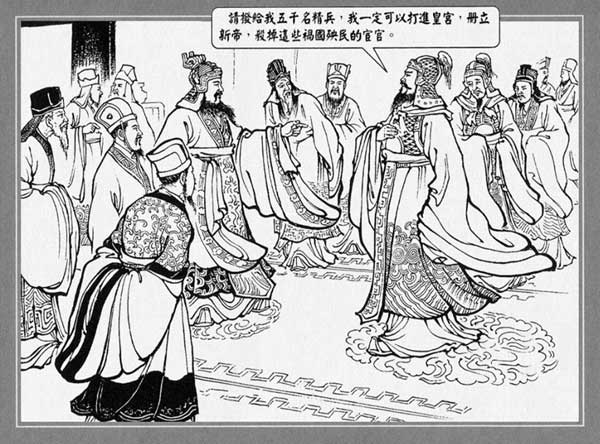
At
once one stood forward, crying, "Give me five thousand veterans, and we
will break into the Palace, set up the true heir, slay the eunuchs, and sweep
clean the government! Then peace will come to the empire."
The
energetic speaker was Yuan Shao, son of the former Minister of the Interior
Yuan Feng and nephew of Imperial Guardian Yuan Wei. Yuan Shao then held the
rank of Imperial Commander.
He
Jin mustered five thousand royal guards. Yuan Shao put on complete armor and
took command.
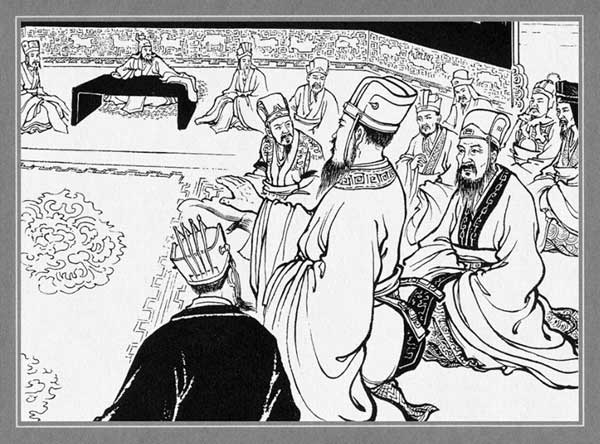
He
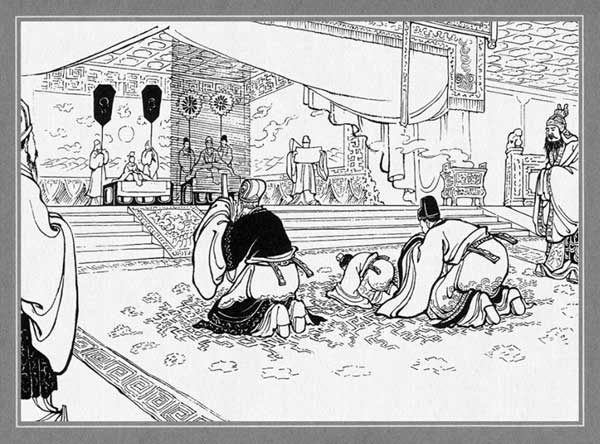
Jin, supported by He Yong, Xun You, Zheng Tai, and more than thirty other
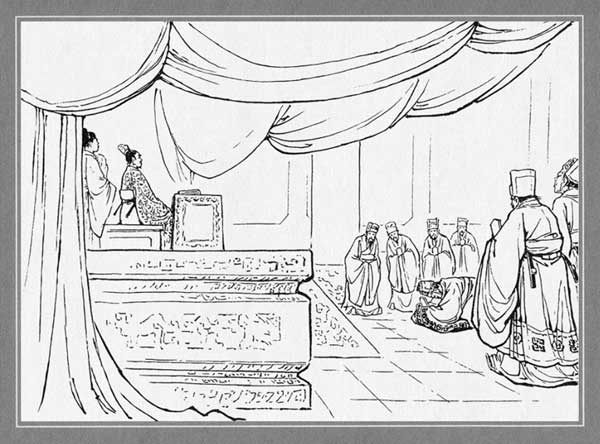
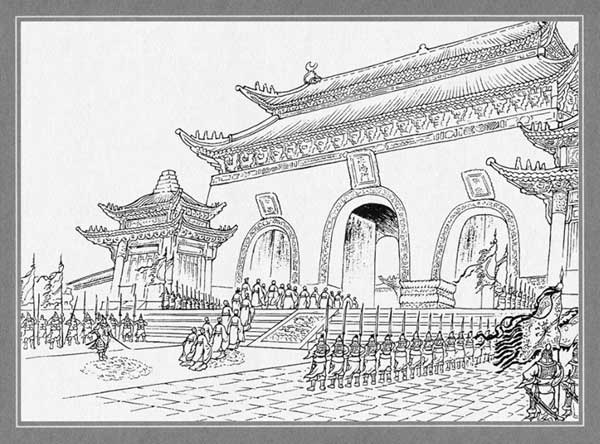
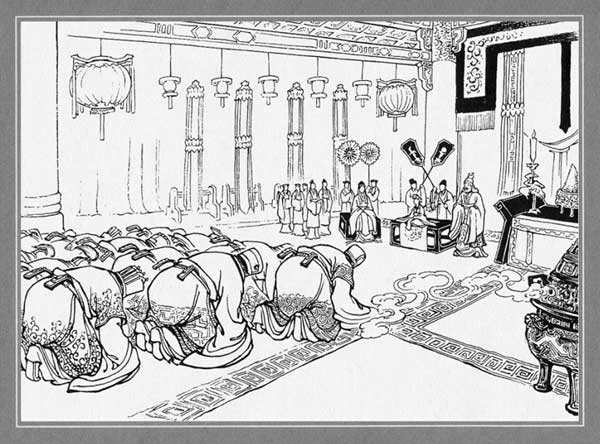
ministers and high-rank officials, went into the Palace. In the hall where lay
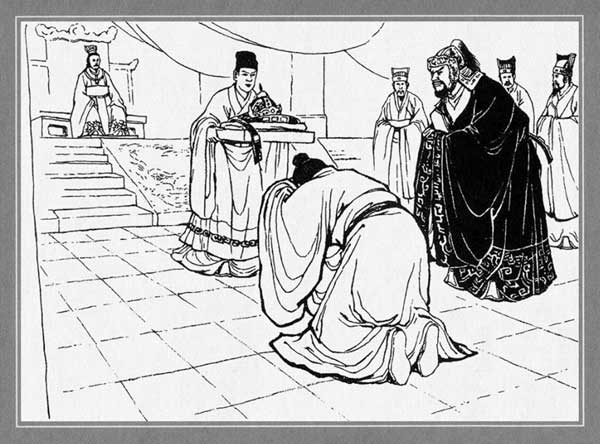
the coffin of the late Emperor, they placed Liu Bian on the throne.
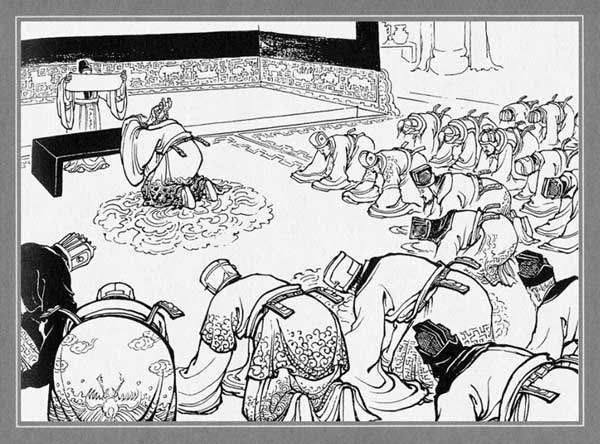
After the ceremony was over
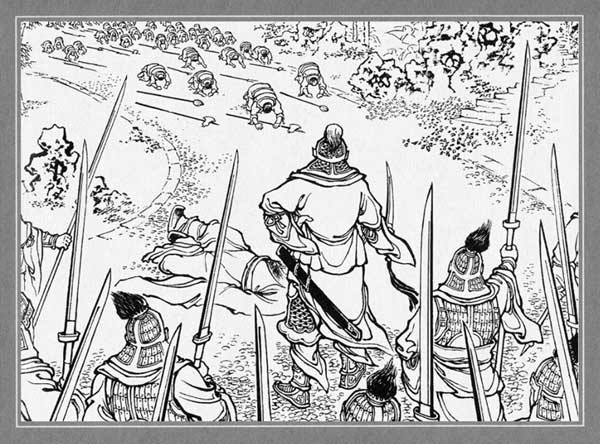
and all had bowed before the new Emperor, Yuan Shao went in to arrest Eunuch
Jian Shuo. Jian Shuo in terror fled into the Palace garden and hid among the
shrubs, where he was discovered and murdered by Guo Sheng, one of the Ten
Eunuchs. The guards under Jian Shuo's command all surrendered.
Yuan
Shao said, "Their gangs have broken. The most opportune moment is now to
slay all the eunuchs!"
But
Zhang Rang and the eunuchs of the Ten scented the danger and rushed to see
Empress He.
They
said, "The originator of the plan to injure your brother was Jian Shuo:
Only he was concerned and no other. Now the Regent Marshal, on Yuan Shao's
advice, wishes to slay everyone of us. We implore your pity, O Your Majesty!"
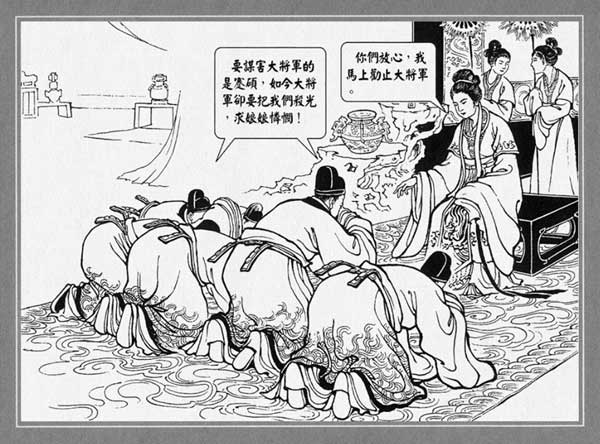
"Fear not!" said Empress He, whose son had just become
Emperor, "I will protect you."
She
sent for her brother, and said, "You and I are of lowly origin, and we owe
our good fortune to the eunuchs. The misguided Jian Shuo is now dead, and need
you really put all the others to death as Yuan Shao advises?"
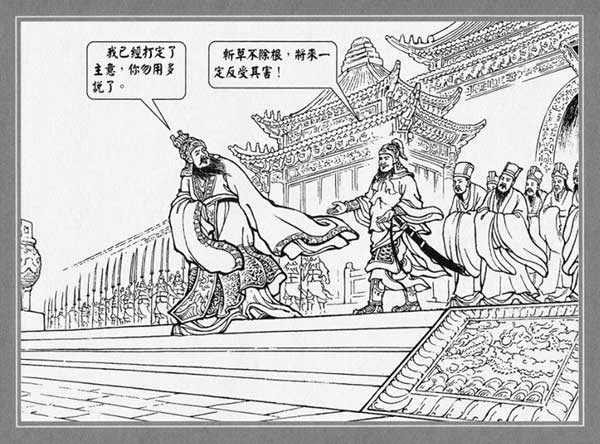
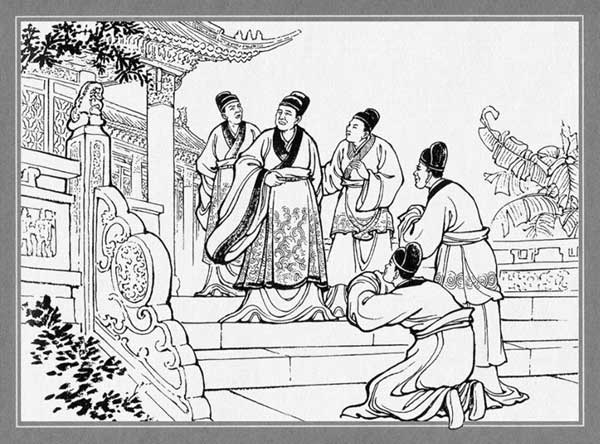
And He Jin obeyed her wish. He explained to his party, saying, "The real offender, Jian Shuo, has met his fate, and his clan will be punished. But we need not exterminate the whole party nor injure his colleagues."
"Slay them, root and branch," cried Yuan Shao, "or they will ruin you!"
"I have decided," said He Jin, coldly. "Say no more."
Within a few days He Jin became Chair of the Secretariat, and his associates received high offices.
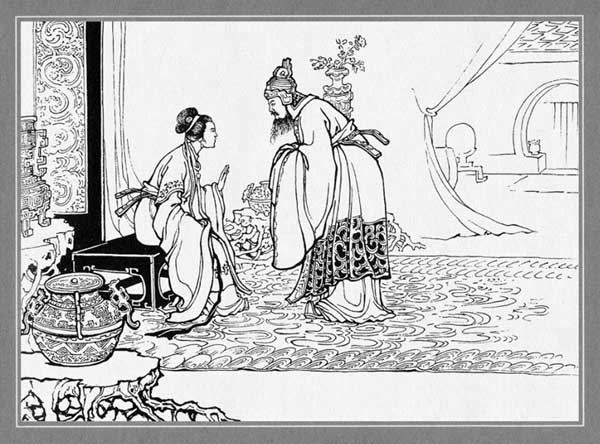
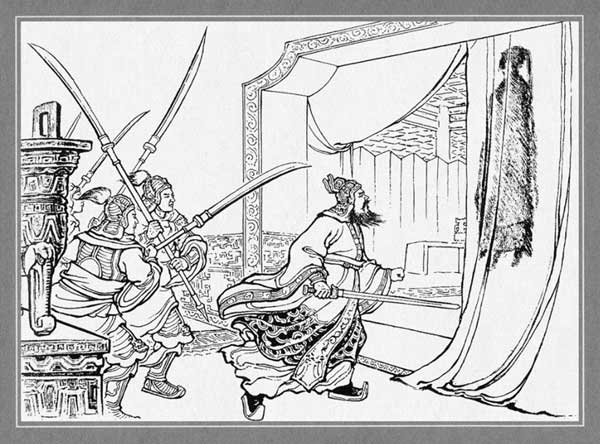
Now Empress Dong summoned the eunuch Zhang Rang and his party to a council.
Said she, "It was I who first brought forward the sister of He Jin. Today her son is on the throne, and all the officials are her friends, and her influence is enormous. What can we do?"
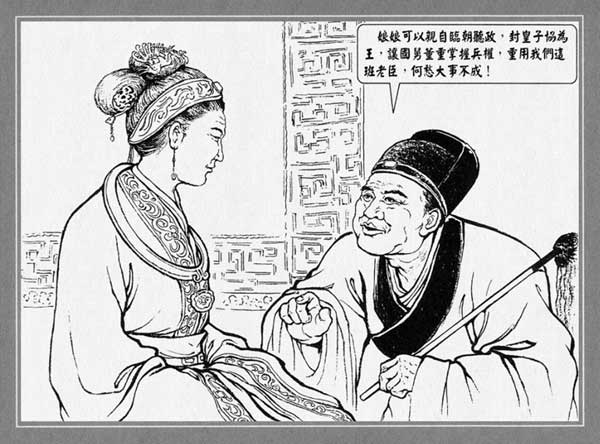
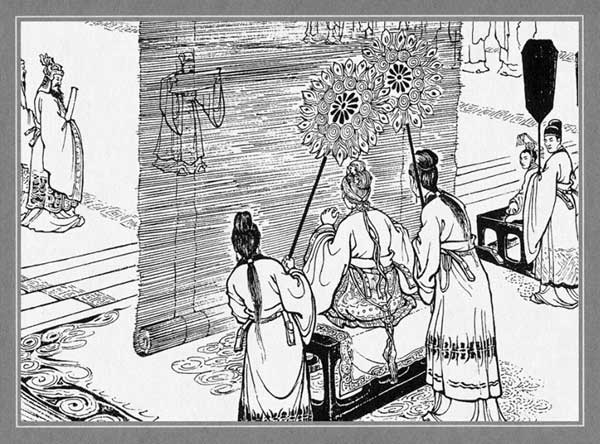
Zhang Rang replied, "Your Highness should administer the state from 'behind the veil'; create the late Emperor's son Liu Xian a prince; give your brother, the Imperial Uncle Dong Chong, a high rank, and place him over the army; and use us. That will do it."
Empress
Dong approved. Next day she held a court and issued an edict in the sense
proposed. She made Liu Xian Prince of Chenliu and Dong Chong General of the
Flying Cavalry, and she allowed the eunuchs again to participate state affairs.
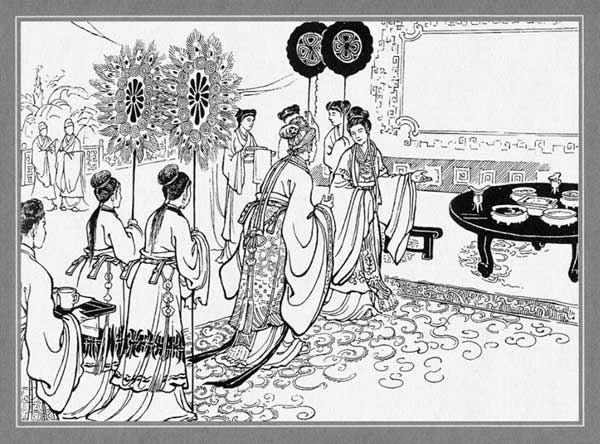
When
Empress He saw this, she prepared a banquet to which she invited her rival
Empress Dong.
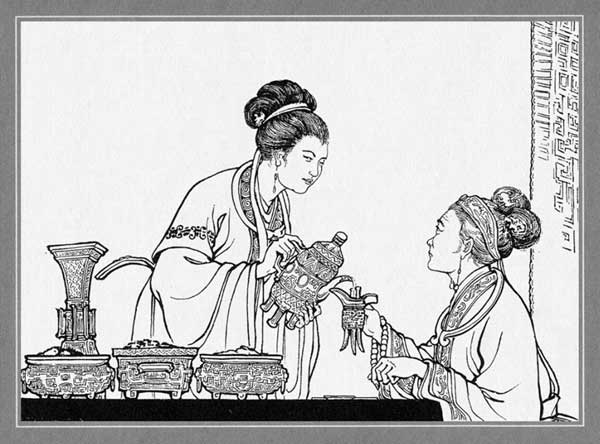
In
the middle of the feast, when all were well warmed with wine, Empress He rose
and offered a cup to her guest, saying, "It is not fitting that we two
should meddle in state affairs. In the beginning of the Han Dynasty, when
Empress Lu laid hands upon the government, all her clans were put to death. We
ought to remain content, immured in our palaces, and leave state affairs to the
state officials. That would be well for the country, and I trust you will act
thus."
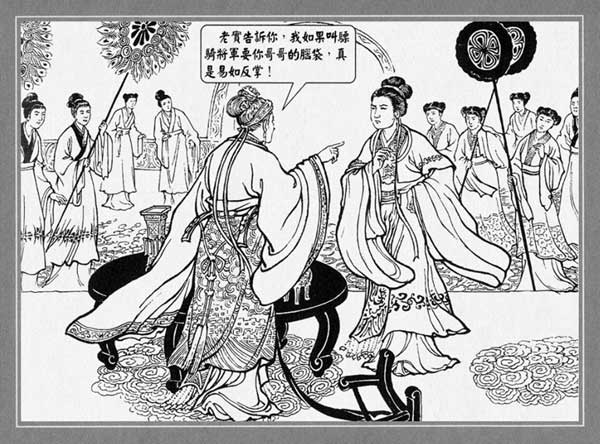
But
Empress Dong only got angry, saying, "You poisoned Lady Wang out of jealousy.
Now, relying upon the fact that your son sits on the throne and that your
brother is powerful, you speak these wild words. I will command that your
brother be beheaded, and that can be done as easily as I turn my hand!"
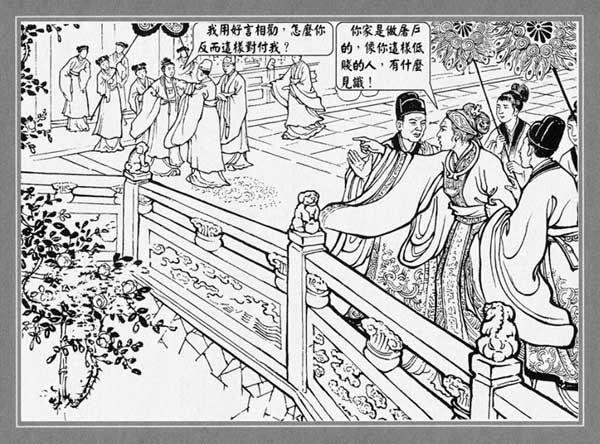
Empress
He in her turn became wroth and said, "I tried to persuade you with fair
words. Why get so angry?"
"You
low born daughter of a butcher, what do you know of offices?" cried
Empress Dong.
And
the quarrel waxed hot.
The
eunuchs persuaded the ladies to retire.
But
in the night Empress He summoned her brother into the Palace and told him what
had occurred. He went out and took counsel with the principal officers of
state.
Next
morning a court was held and a memorial was presented, saying:
"Empress
Dong, being the foster mother of Liu Xian, Prince of Chenliu, a regional
prince---only a collateral---cannot properly occupy any part of the Palace. She
is to be removed into her original fief of Hejian and is to depart
immediately."
And while they sent an
escort to remove Empress Dong, a strong guard was placed about the Imperial
Uncle Dong Chong's dwelling.
They
took away his seal of office and he, knowing this was the end, killed himself
in his private apartments. His dependents, who wailed his death, were driven
off by the guards.
The eunuchs Zhang Rang and
Duan Gui, having lost their patroness, sent large gifts to He Jin's younger
brother, He Miao, and his mother, Lady Wuyang, and thus got them to put in a
good word to Empress He so as to gain her protection. And so they gained favor
once more at court.
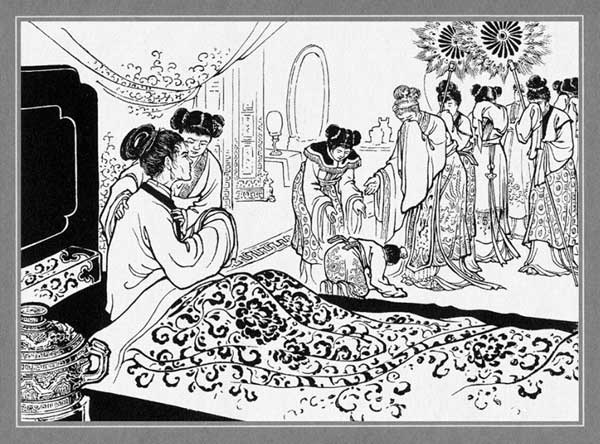
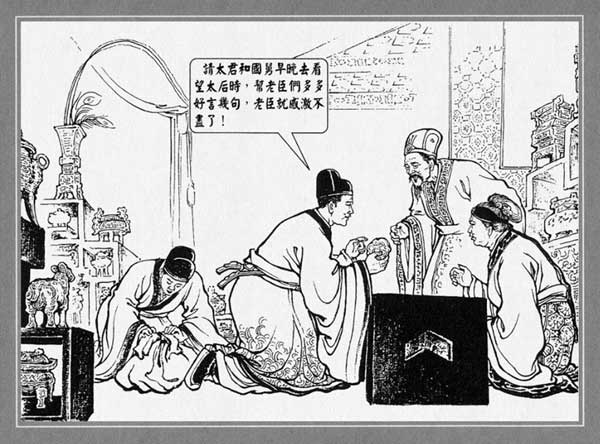
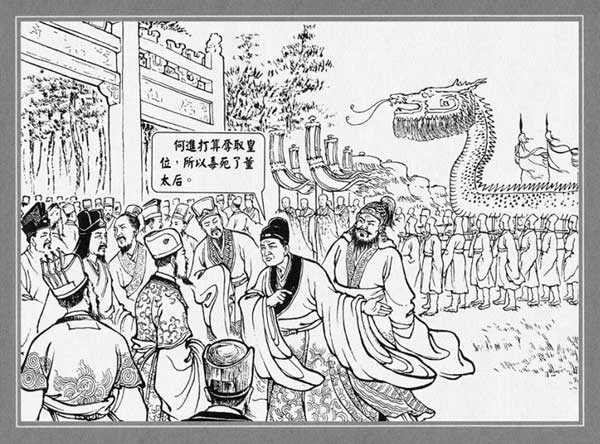
In
the sixth month of that year, the secret emissaries of He Jin poisoned Empress
Dong in her residence in the country. Her remains were brought to the capital
and buried in Wen Tombs. He Jin feigned illness and did not attend the funeral.
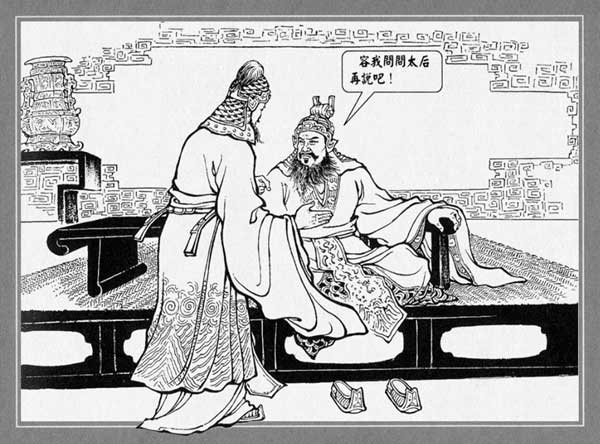
Commander
Yuan Shao went one day to see He Jin, saying, "The two eunuchs, Zhang Rang
and Duan Gui, are spreading the report outside that you have caused the death
of the late empress and is aiming at the throne. This is an excuse for you to
destroy them. Do not spare them this time, or you will pay like Dou Wu and Chen
Fan, who in the previous reign missed their chance because the secret had not
been kept, and they paid by their own deaths. Now you and your brother have
many commanders and officers behind, so that the destruction of the eunuchs can
be but an ease. It is a heaven-sent opportunity. Delay no further!"
But He Jin replied, "Let me think it over."
He
Jin's servants overheard the discussion and secretly informed the intended
victims, who sent further gifts to the younger brother He Miao.
Corrupted
by these, He Miao went in to speak with his sister Empress He and said,
"The General is the chief support of the new Emperor, yet he is not
gracious and merciful but thinks wholly of slaughter. If he slays the eunuchs
without cause, it may bring about revolution."
Soon
after He Jin entered and told her of his design to put the eunuchs to death.
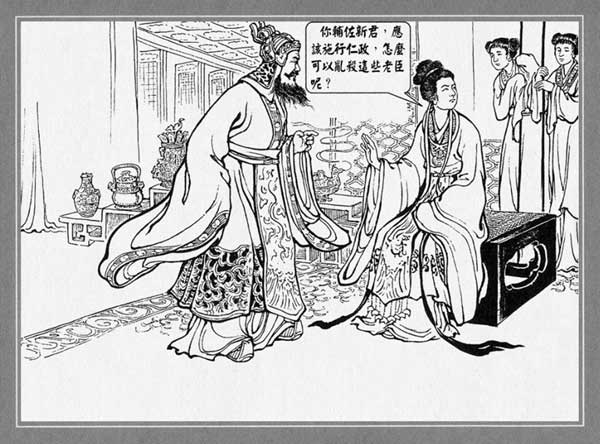
She
argued with him, "Those officials look after palace affairs and are old
servants. To kill the old servants just after the death of their master would
appear disrespectful to the dynasty's ancestral temple."
And
as He Jin was of a vacillating mind, he murmured assent and left her.
"What
about it?" said Yuan Shao on meeting him.
"She
will not consent. What can be done?"
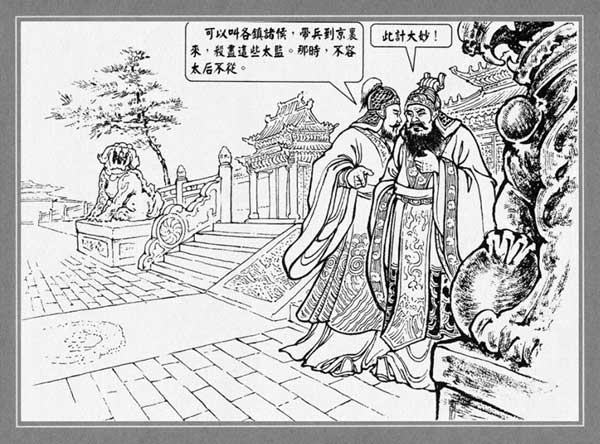
"Call
up an army and slay them. It is imperative. Never mind her consent!"
"That
is an excellent plan," said He Jin.
And
he sent orders all round to march soldiers to the capital.
But
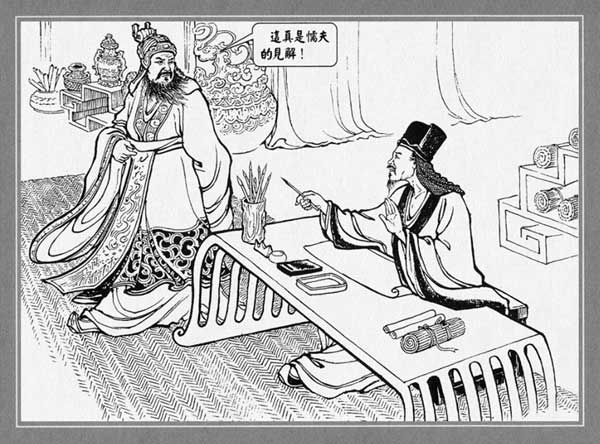
Secretary Chen Lin objected, "Nay! Do not act without due consideration.
The proverb says 'To cover the eyes and snatch at swallows is to fool oneself.'
If in so small a matter you cannot attain your wish, what of great affairs? Now
by virtue of the emperor and with the army under your hand, you are like
prancing tiger and soaring dragon: You may do as you please. To use such
enormous powers against the eunuchs would bring victory as easily as lighting
up a furnace to burn a hair. You only need to act promptly: Use your powers and
smite at once, and all the empire will be with you. But to summon forces to the
capital, to gather many bold warlords into one spot, each with different
schemes, is to turn our weapons against our own person, to place ourselves in
the power of another. Nothing but failure can come of it, and havoc will
ensue."
"The
view of a mere book-worm," said He Jin with a smile.
Then
one of those about He Jin suddenly clapped his hands, laughing, "Solving
this issue is as easy as turning over one's hand! Why so much talk?"
The speaker was Cao Cao.
Wouldst thou withdraw wicked people from thy prince's side,
Then seek counsel of the wise people of the state.
What
Cao Cao said will be disclosed in later chapters.
|
|
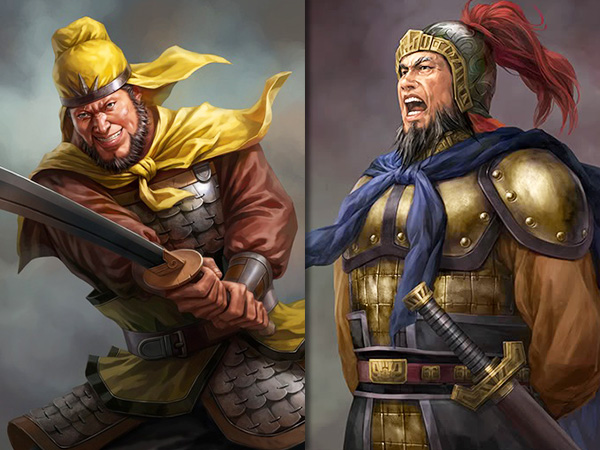
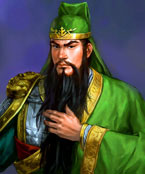
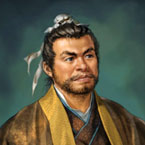
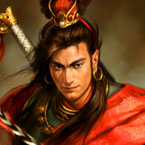
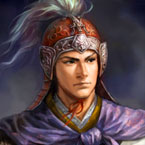
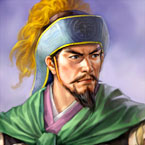
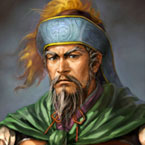
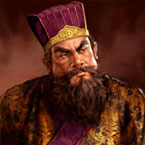
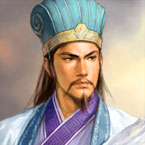
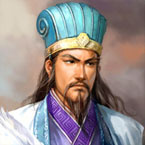
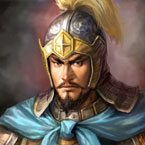
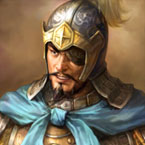
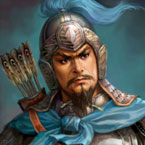
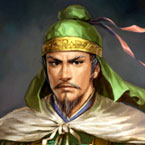
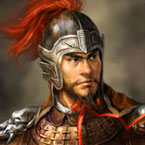
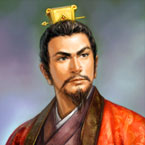
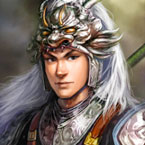
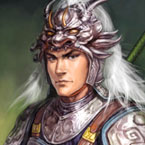
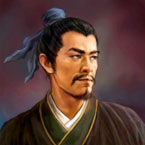
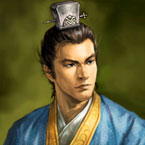
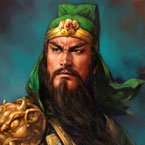
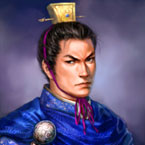
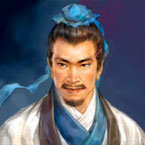
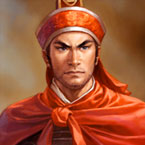
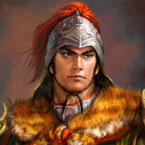
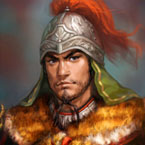
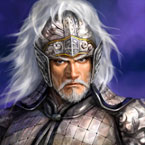
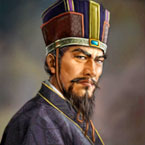
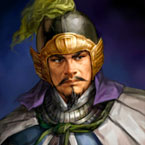
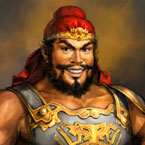
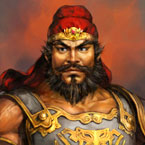
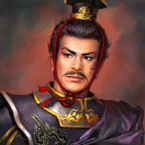
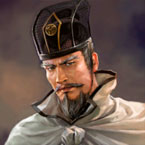
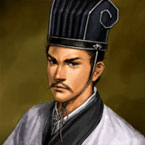
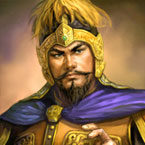
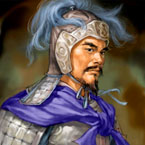
Gao Sheng & Zhu Jun
|
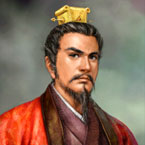
|
|
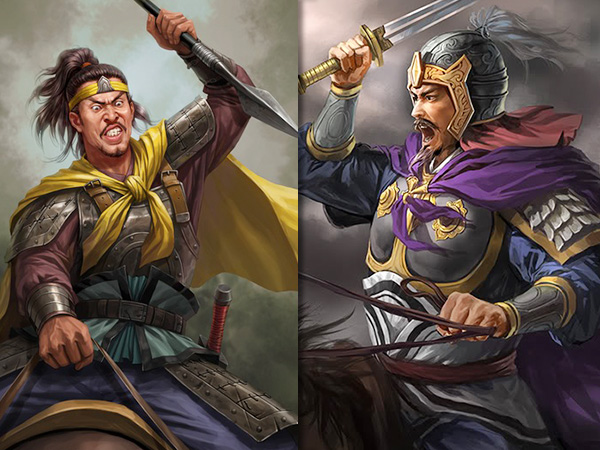
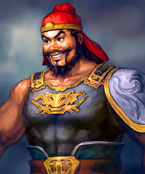
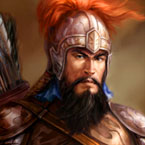
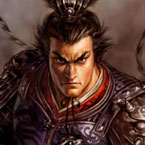
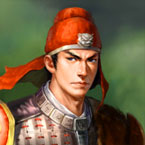
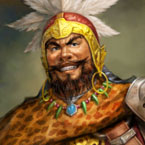
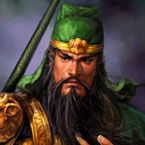
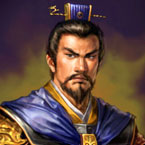
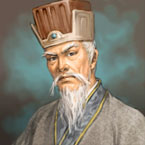
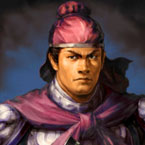
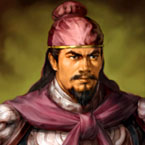
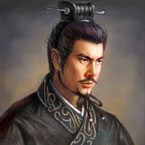
Han Zhong Huangfu Song
|
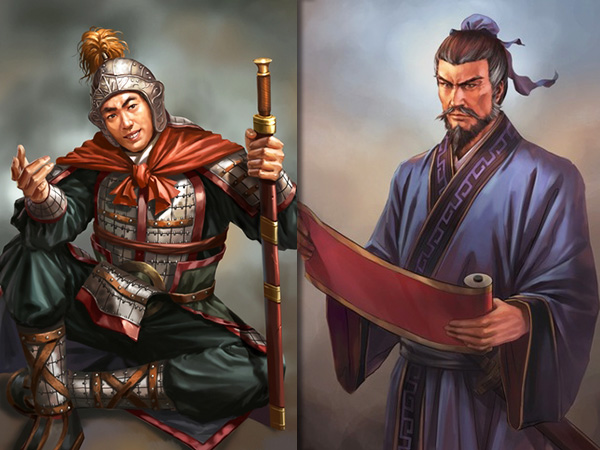
|
|
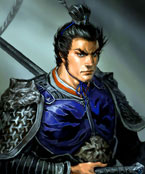
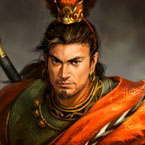
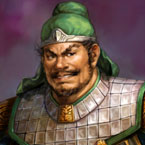
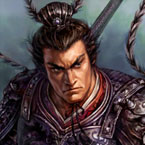
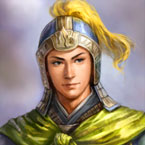
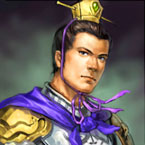
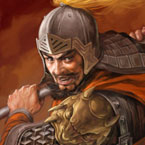
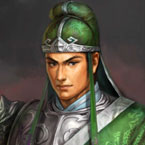
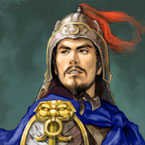
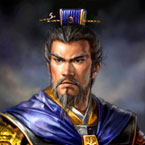
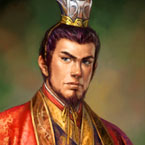
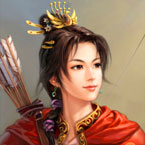
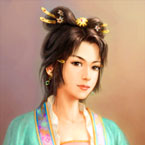
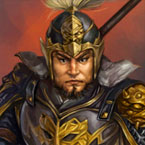
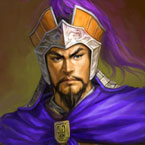
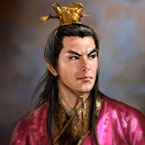
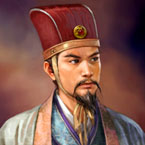
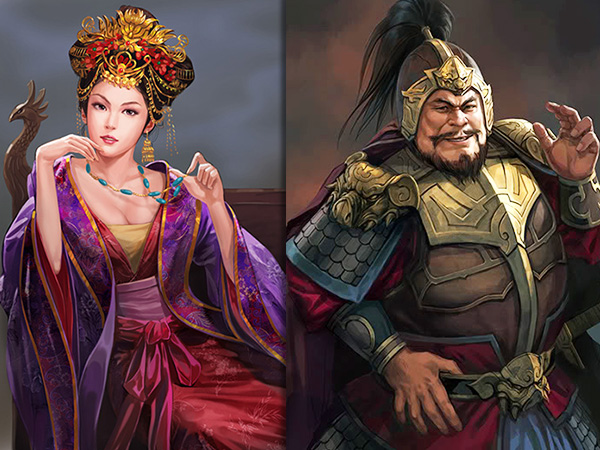
Xu Chang & Lu Zhi
|
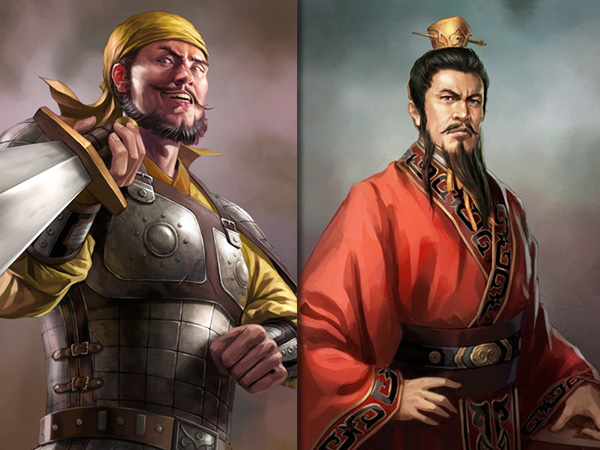
|
|
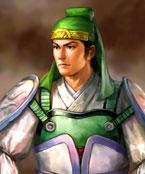
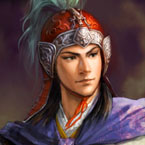
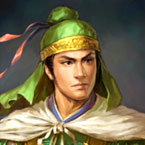
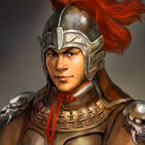
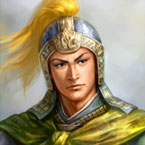
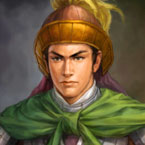
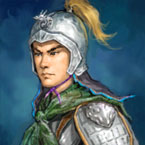
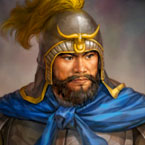
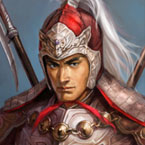
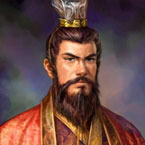
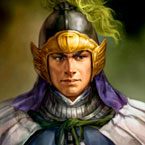
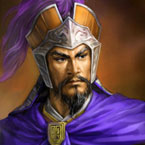
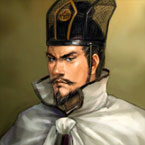
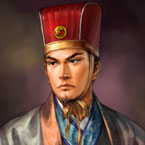
Yan Zheng & Liu Yu
|
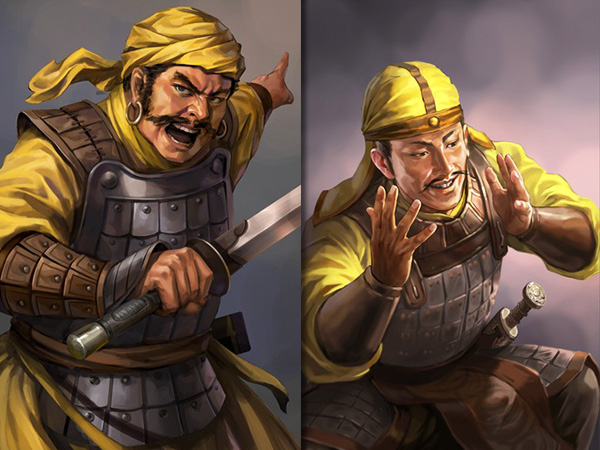
|
|
Sun Zhong & Zhao Hong
|
















 Xem bản tiếng Việt